How Tax Firms Are Valued by Buyers and Brokers
Multiple frameworks now replace the old revenue rule of thumb.

Tax firm valuation stopped running on a single rule of thumb somewhere in the last few years. Buyers and brokers now reach for different frameworks depending on a firm's size, how much of its revenue repeats month to month, and whether the business can run without its founder in the room. Understanding which metric applies to which firm, and why, is what separates a guess about what a practice is worth from a realistic number.
The old shorthand, 1x gross revenue, came out of an era when most tax practices looked roughly the same: a sole owner, a seasonal client list, and earnings that tracked revenue closely enough that multiplying the top line got you close to a fair price. That logic still holds up for the smallest owner-operator shops, where there isn't much else to measure. But even there, brokers increasingly treat 1x revenue as a floor rather than a formula, a starting point for negotiation rather than the answer itself. Above a certain revenue threshold, the market has moved toward earnings-based pricing, and for good reason: two firms pulling in the same revenue can have wildly different margins, client retention, and service mix, none of which a revenue number captures on its own. Transaction volume has climbed steadily, and multiple frameworks now compete for the same deals as buyers have grown more sophisticated, not less.
The three metrics buyers and brokers use
Revenue multiples still do a lot of work at the smaller end of the market. They matter most when client transferability, not earnings quality, is the thing a buyer is actually paying for. A seasonal, tax-prep-only shop and a year-round firm doing bookkeeping, payroll, and advisory work will price on very different ranges even at identical revenue, because a buyer of the seasonal shop is really just buying a client list and hoping it sticks. According to CT Acquisitions' 2026 data, small practices under a couple million dollars in revenue trade between 0.8x and 1.2x annual revenue, and that range functions as common language during early screening even when the eventual deal ends up priced on earnings.
Seller's Discretionary Earnings, or SDE, fits a specific kind of firm: one owner doing most of the production, the management, and the client relationship work, with a buyer expected to step into that exact seat. It falls apart once there are multiple partners, a management layer, or real replacement costs involved in keeping the practice running, because SDE assumes a single person's labor can be swapped out cleanly, and that assumption stops being true past a certain size. Based on a large sample of accounting firm transactions, the median deal prices around 1x revenue, and the SDE multiple that corresponds to that level tends to be in a fairly narrow band. What actually moves a firm within that band isn't the raw SDE number so much as the SDE margin: a firm generating a given amount of SDE off a certain revenue figure looks nothing like one generating that same amount of SDE off double that revenue, even though the dollar figure is identical.
Adjusted EBITDA is what serious acquirers and PE-backed platforms actually underwrite. It strips out ownership structure and measures cash generation the business can sustain on its own, which matters because CPA firm partners routinely run every dollar of profit through compensation, leaving unadjusted financials nearly useless for pricing purposes. Normalizing owner comp is the step that makes or breaks the number: adjust it correctly and the EBITDA line can shift materially, and that shift flows straight through to the final price. CT Acquisitions' 2026 data puts established, multi-preparer practices above a certain EBITDA threshold at 4x to 7x EBITDA, a range wide enough that the adjustments themselves often decide where a given firm lands.
None of these numbers mean anything in isolation. A broker who quotes a multiple without saying what it's a multiple of, and without explaining how they got to that earnings figure, hasn't told a seller anything useful yet.
What the transaction market looked like in 2025
BizBuySell's 2025 benchmark data offers the clearest market-level snapshot of small and mid-size practice sales. Median sale price hit $500,000 in 2025, a 25% gain over the prior five years. Average earnings multiples reached 2.34 and revenue multiples reached 1.11, both above their five-year averages of 2.23 and 1.07. Median revenue rebounded to $440,000, the highest mark in five years, median earnings climbed to nearly $247,000, and profit margins came in strong at 56.1%.
Size still does a lot of the pricing work inside that data. A practice consistently pulling in over $700,000 a year can sell for an earnings multiple above 2.6, while one under $200,000 tends to land closer to 1.6 or lower, per BizBuySell. The 2024-to-2025 shift saw 2024 bring a wave of smaller, highly profitable practices to market, which pushed margins up to a five-year high of 61.5% while dragging revenue medians down. The 2025 rebound reflects the opposite: larger, more diversified practices transacting, which lifted revenue medians even as margins settled back down. Elsewhere in the market, the professional, scientific, and technical services sector saw revenue multiples climb 16% in 2025, according to the DealStats Value Index, a sign that buyers are paying up for specialized expertise and revenue that repeats.
BizBuySell's numbers skew toward smaller, independently listed practices. The upper end of the market, where PE-backed platforms are buying, runs on different multiples and different logic entirely, covered later in this piece.
The factors that move a multiple up or down within any given range
Recurring revenue does more to move a multiple than almost anything else on this list. Per CT Acquisitions, citing AICPA Pulse Survey data and CPA deal flow through 2024 and 2025, firms with over 50% recurring monthly revenue trade at an EBITDA premium compared to project-based or seasonal firms of the same size. Buyers pay up for it because predictable cash flow is worth more than the same dollar earned once a year, customer acquisition cost drops when a client already pays monthly, and recurring engagements tend to pull clients toward advisory work over time.
Service mix carries its own risk premium, and tax prep sits on the wrong side of it. Thomson Reuters Institute's State of Tax Professionals Report notes that as prep automation keeps improving, clients grow indifferent about who actually files their return, or start handling simpler returns themselves. A firm with real advisory depth has broader revenue and client relationships a buyer can defend; a seasonal prep-only shop has neither. Outsourced CFO work is at the top of the pile: CT Acquisitions puts it at 1.5x to 2.0x the multiple of seasonal tax-prep revenue, because it's recurring, contracted, and woven into how the client's business actually runs. Firms with a substantial base of fractional CFO revenue and ten or more active engagements trade at the top of the EBITDA range for a reason.
Owner dependency is the other side of that coin, and brokers sometimes call it the beer truck scenario: if a firm's clients are tied to one founder or partner, the practice is worth structurally less, according to Thomson Reuters Institute, because the value walks out the door with that person. Age matters here too. A firm where 60% of equity partners are past 60 and have already signaled they want out within three to five years carries a very different risk profile than one where 60% of partners are under 50 with a decade and a half of runway ahead of them. CT Acquisitions notes this risk appears in two places at once: a compressed headline multiple, often a discount of 0.5x to 1x to reflect succession risk, and deeper earnout structures that push more of the payment into the future.
Staff continuity and technology readiness matter almost as much. A team willing to stay on after the sale is a real asset on the balance sheet, informally speaking, while high turnover or a wave of looming retirements compresses value fast. Cloud-based, integrated firms are widely viewed as easier to migrate and scale, and that kind of operational readiness has become a prerequisite for buyers now, not a nice-to-have. A firm still running on manual processes and paper files isn't going to attract an institutional buyer or a scale-up acquirer, full stop.
Founder pedigree is visible in the numbers too. CT Acquisitions finds that boutique firms led by former Big 4 partners, from PwC, Deloitte, EY, or KPMG, command a 0.3x to 0.7x revenue premium, reflecting how buyers read audit quality and access to enterprise clients. And client profile matters regardless of everything else on this list: a roster full of aging retirees is worth less than one full of growing business owners, and heavy concentration in a handful of clients is a discount factor no matter how big the revenue number looks.
Firm Lever has observed that owners routinely leave up to 30% of potential deal value on the table simply through poor preparation. Two firms that look identical on paper can draw very different bids depending on how well they're positioned going into a sale.
How the buyer's identity shapes the valuation framework they apply
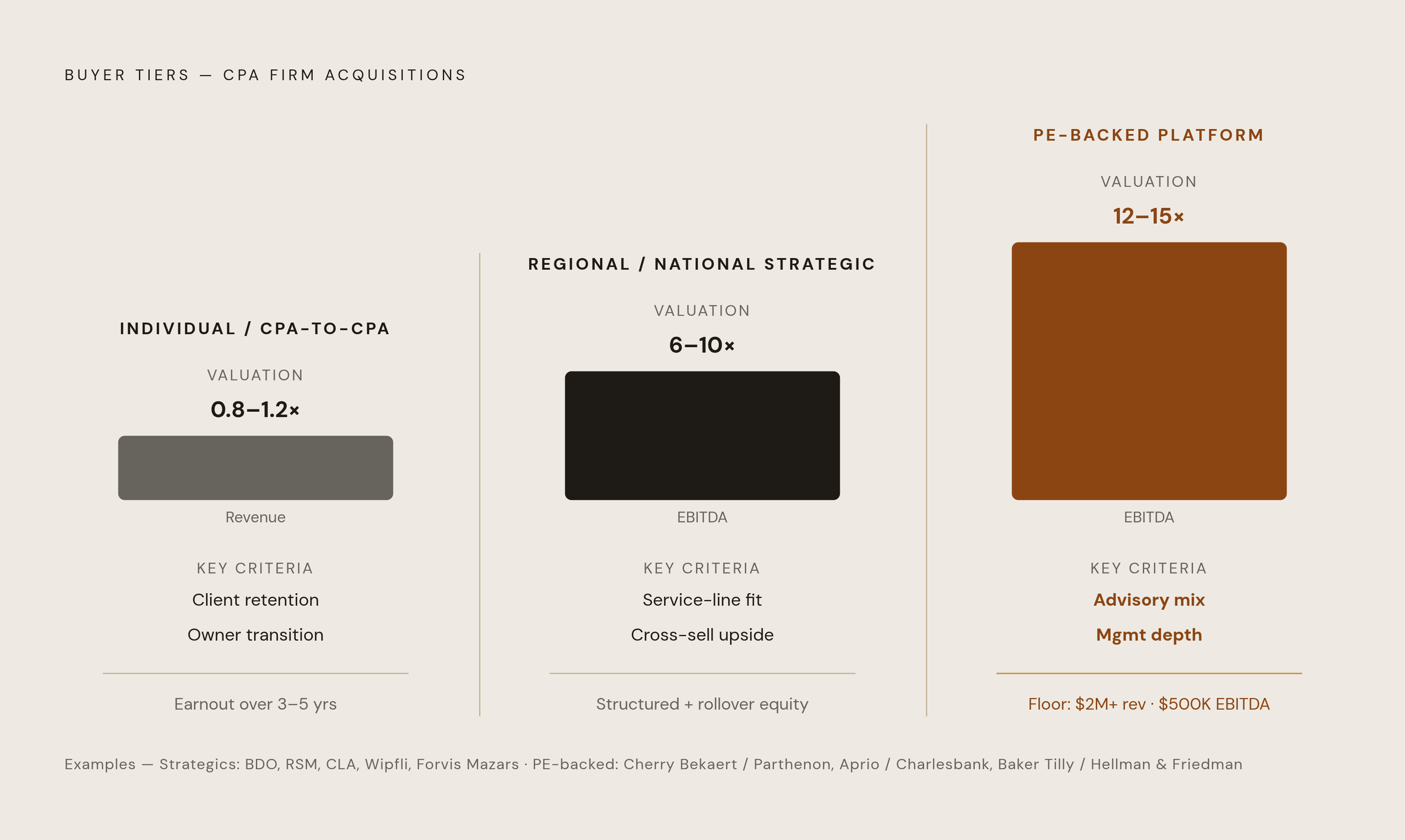
Individual buyers and CPA-to-CPA succession deals tend to price on revenue or SDE, and they care most about whether client relationships will actually transfer and whether the seller sticks around long enough to make that happen. Internal partner buyouts price on their own logic: an internal successor already has the relationships in hand and never has to compete in a bidding process, which shapes the number from the start. The typical CPA-to-CPA succession deal gets structured around trailing-twelve-month revenue with payouts spread over time rather than paid at close.
Regional and national strategic acquirers, firms like BDO USA, RSM, CliftonLarsonAllen, Wipfli, and Forvis Mazars, are active buyers at the smaller end of the market too, but they price differently. They're looking at normalized EBITDA alongside service-line fit, talent, geography, and cross-sell potential, not just whether the client list will transfer cleanly.
PE-backed platforms have become the dominant bidder class for firms above a certain EBITDA threshold with a real advisory practice attached. Cherry Bekaert, backed by Parthenon Capital since 2022, has completed more than fourteen acquisitions, including Spicer Jeffries and Herbein + Company in 2025. Aprio, backed by Charlesbank Capital Partners since July 2024, picked up Pontiff + Associates and other firms across 2024 and 2025. EisnerAmper carries backing from TowerBrook. Baker Tilly, backed by Hellman & Friedman, announced a merger with Moss Adams in April 2025 that closed in early June at a substantial valuation. CBIZ acquired Marcum in a sizable transaction. These platforms generally set entry criteria at a revenue floor in the low millions and an EBITDA floor well into six figures, and they pay strategic premiums for advisory mix and geographic fit that individual buyers simply don't value the same way. They're also weighing things an individual buyer never has to think about: management depth, how standardized the workflows are, technology integration, room to bolt on future acquisitions, and what the platform itself will be worth at its own eventual exit.
A firm heading toward a sale needs to know, honestly, which of these three buyer classes it's actually going to attract, because the prep work, and the multiple on offer, differ enormously across them.
What private equity's dominance in accounting M&A means for how firms are priced today
PE-backed accounting transactions rose notably in 2025 compared to prior years, and industry observers estimate that a substantial share of the top 30 US accounting firms by revenue have now sold a stake to private equity. That's not a niche trend anymore; it's reshaping how the whole market prices deals.
PE buyers aren't just underwriting current earnings. They're underwriting platform readiness: can this firm absorb bolt-on acquisitions, standardize its workflows across offices in different states, and support a higher-multiple exit down the road for the PE firm itself? That question splits the market into two tiers. Firms with the scale, the recurring revenue, the management bench, and the technology infrastructure PE wants attract competitive bids and premium EBITDA multiples. Firms that don't meet that bar get priced by a much smaller pool of individual and regional buyers, at meaningfully lower multiples. The gap between those two tiers isn't a rounding error, it's structural, and it's only getting wider as more capital chases the firms that qualify.
The headline multiple isn't the whole story either. PE deals often carry rollover equity, earnouts tied to retention and growth after close, and seller notes, which means the number printed in the deal announcement and the cash a seller actually walks away with at closing can look very different. Thomson Reuters Institute's 2025 State of Tax Professionals Report found growth jumped to the second-highest strategic priority for firms worldwide in 2025, up from fifth place in 2024, which suggests firm leaders have noticed the consolidation wave and are already positioning for it.
How operational choices practitioners make today translate directly into valuation outcomes later
A useful distinction: a practice built around one owner's personal relationships and technical labor is really a job with a business wrapped around it, and a buyer prices that very differently from an actual business, regardless of how much revenue it books. Getting from one to the other is a mindset shift as much as an operational one.
Recurring revenue gets built, not discovered sitting somewhere in the client list. Moving clients off annual compliance engagements and onto monthly advisory relationships changes the valuation basis of the firm, not just its revenue mix on a spreadsheet. Automating the routine parts, intake, document review, basic compliance work, frees up the hours practitioners need to actually do that advisory work, which is exactly the kind of client relationship that earns a recurring-revenue premium at exit. Tax workflow tools built specifically to cut down on manual triage make a firm legible to a buyer during diligence and easier to migrate once the deal closes.
Succession planning is a valuation lever that reaches well beyond an HR concern. Identifying and developing the people who'll hold client relationships five years from now reduces the partner-dependency discount a buyer will otherwise apply. Client roster discipline matters just as much: knowing which clients are high-value and which are dragging down margin, and pruning or re-pricing the latter, improves EBITDA margin and the overall quality of earnings a buyer is willing to underwrite. Firm Lever's point about lost value comes back to timing above all else: treating a sale as a multi-year project rather than something that happens suddenly gives a firm time to actually fix the metrics buyers will test during diligence.
Every buyer, regardless of size or type, is purchasing future cash flow and betting on whether that cash flow will survive the transition. Revenue earned last year matters far less than whether next year's revenue occurs without the founder in the room to make it happen. Every operational choice that makes earnings more durable, more predictable, and less tied to any single person is, in the end, a choice that raises the number a buyer is willing to pay.
Sources
- Tax Preparation Business Valuation: Free Calculator. What's Your Tax Prep Practice Worth in 2026?
- Accounting & Tax Practice Business Valuation Multiples & Financial Benchmarks - BizBuySell Report
- Preparing for growth: What tax firm leaders must know about firm valuation and strategic scaling | Thomson Reuters Institute
- Complete Guide to Selling Accounting Practice
- ctacquisitions.com
- kmco.com
- ctacquisitions.com
- kmco.com