Automating Team Handoffs During Tax Engagements
Automation at handoff points cuts coordination work that does not require professional judgment.

Automating team handoffs during tax engagements is the highest-leverage way to reclaim capacity because it removes coordination work between professional tasks. For solo tax practitioners and enrolled agents who want to grow without hiring, a practical stack has tools for intake and status automation, tax-specific document extraction, and agentic preparation where the software supports it. The strongest results come from standardizing each transition first, then automating it without surrendering professional judgment.
Why handoffs—not preparation—are where tax engagement time disappears
The question “where is this?” exposes a familiar bottleneck. A return is waiting, but it sits in no one’s queue because the previous task ended without a clear assignment or status signal. The preparer may have completed the work correctly. Yet the engagement cannot advance until someone locates the documents, establishes what is complete, and identifies the next owner. That coordination consumes capacity without improving the tax analysis.
Roughly 40 to 60 percent of total engagement time goes to tasks that do not require professional judgment. Handoffs concentrate much of that work across intake, document collection, data entry, preparation, review, delivery, and filing. The lifecycle itself is predictable and repeatable. The friction comes from different tools, logins, and conventions at its boundaries. A document silo, a routing delay, and a missing status signal are separate failures within the same engagement, so faster preparation alone cannot resolve them.
How fragmented systems turn routine coordination into compounding delay
Thomson Reuters identifies disconnected systems as a defining workflow bottleneck for tax professionals. When engagement data cannot move between systems, staff must transfer both the information and the context needed to interpret it. Humans become the integration layer between tools. A document may be available in one system while its absence still blocks work in another. Without shared status information, the firm also struggles to see where capacity is available.
These gaps compound as the engagement moves downstream. A missed document follow-up delays preparation, while an undocumented handoff convention can become an error under volume pressure. Hiring staff for intake cannot clear a review queue, and adding a reviewer cannot fix how documents move between document tools and tax software. Each fix must address the handoff where work gets stuck.
Tool sprawl makes that diagnosis harder because each application holds only part of the engagement. Staff spend time switching between systems instead of getting work done, and each added vendor that holds client data adds to the security risk. Better organization can help people navigate these gaps. It cannot make disconnected systems share information. The structural remedy is a workflow that keeps documents, assignments, and status signals together, eliminating the need for someone to reconstruct them.
What is actually at stake when a handoff breaks — compliance exposure, talent, and revenue
A broken handoff can create compliance exposure without deliberate misconduct. When context gets lost between preparer and reviewer, they can miss a due diligence requirement even though both think the return is moving along as it should. The resulting risk extends beyond a late delivery. It can include preparer penalties and professional liability. Preserving context at the transition is therefore a control.
The One Big Beautiful Bill Act, enacted July 2025, added a per-failure penalty for those who meet its specific definition of COVID-ERTC Promoters and fail due diligence when they advise on a COVID Employee Retention Credit document. That regime does not apply generally to all return preparers. Its scope must remain explicit in any compliance assessment. Separately, the IRS expanded Tax Pro Account in February 2026 with business-level digital capabilities and greater visibility into Centralized Authorization File relationships. Firms that cannot connect those digital touchpoints to internal workflows face another coordination gap.
Handling handoffs by hand adds to burnout, while modern tools and the chance to do strategic work help draw talent to a firm. Thomson Reuters Institute reports that a majority of tax professionals want AI to move them toward higher-judgment work, including structuring, advising, and strategizing. Capacity has a purpose beyond processing more returns. For a solo practitioner, reducing coordination can make room for advisory revenue without adding employees, while a larger firm can redirect experienced staff toward work that requires their expertise.
The five handoff points in a tax engagement where automation has the highest leverage
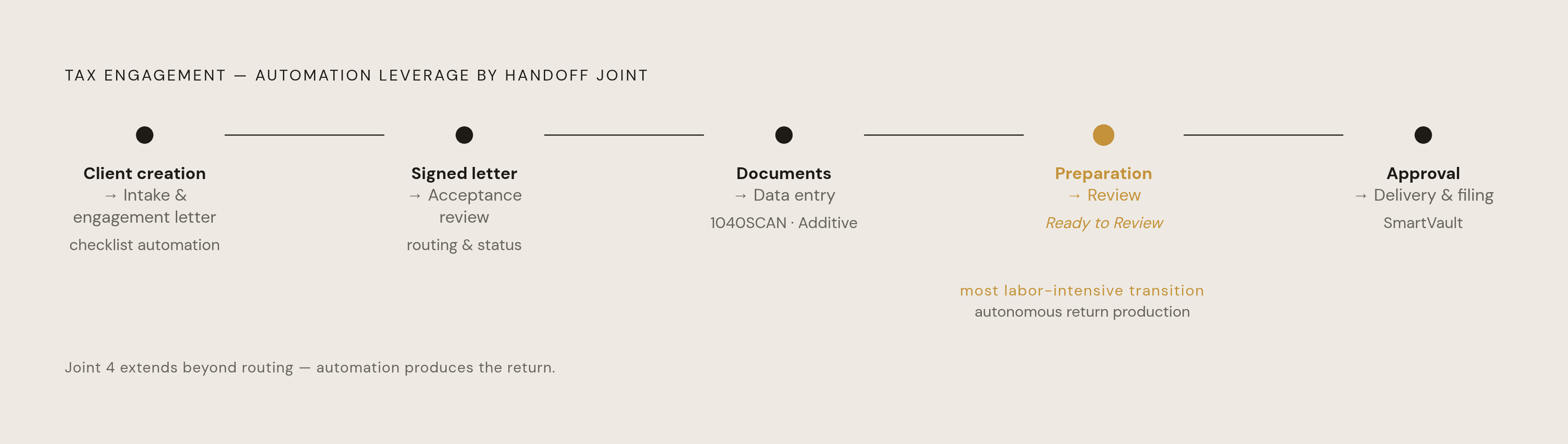
The first joint in the pipeline connects client creation to intake. A new client record can trigger an intake checklist, an engagement letter through a centralized portal, and an assignment to the responsible person. Follow-up reminders address questionnaires not returned within a defined window. Consistency begins before any tax work starts. This prevents onboarding from depending on whether the person handling it remembers every request.
The second joint connects the signed engagement letter to acceptance review. A signature on a PDF should create a human-owned review task. Onboarding opens only after confirmation under firm policy. That distinction separates receipt from acceptance. It also creates a defined handoff that can be explained to the engagement partner, operations, security, and billing rather than leaving each function to interpret the document independently.
Once the engagement is accepted, the third joint moves collected documents into data entry. Thomson Reuters 1040SCAN automates source-document extraction so staff have less to rekey by hand across a wide range of tax documents. Thomson Reuters Additive is built for Schedule K-1 and K-3 forms and the state and international documents that go with them. The choice depends on the document bottleneck. Broad extraction coverage serves a different need from specialized parsing of documents that can stall a complex return.
The fourth joint moves preparation into review with the necessary context intact. This is the most labor-intensive transition, and it is where automation can extend beyond routing into return production. Thomson Reuters Ready to Review supports that shift for 1040 preparation. Its role differs from a reminder or assignment rule. Rather than simply moving completed work, it can produce a substantially complete return for the reviewer, subject to the limits of the supported scenario.
The fifth joint connects approval to delivery and filing status. The workflow needs to get the approved return to the client and keep status signals, e-file confirmation, and filing records up to date across systems. SmartVault connects document management with tax preparation software, including Lacerte, ProSeries, ProConnect Tax, UltraTax CS, Drake, and CCH. That integration addresses the file-movement part of the handoff. It completes the chain by reducing the need to manually transfer the output of preparation into delivery.
How agentic AI changes the preparer-to-reviewer handoff from routing to autonomous production
Routing automation moves work that already exists. Agentic AI carries out preparation steps that used to need a person to put the return together before passing it on. Ready to Review, built on the CoCounsel platform, uses a gather agent to extract information from source documents and prior returns. A tax preparation agent then runs the data through the engine, applies calculations, and creates and solves diagnostics.
The scope of that autonomy remains specific. Full automation covers simple 1040 scenarios, while more complex returns get semi-automated support that uses both AI and manual input. CLH CPAs & Consultants in Indiana provides a concrete example of the capacity gain. Partner Bob Lange cited approximately one hour of preparation time saved on each simple 1040. Across filing-season volume, that removes a recurring block of preparation work.
Thomson Reuters ONESOURCE Sales and Use Tax AI applies the same production logic to routine, recurring sales and use tax filings across established jurisdictions. Thomson Reuters reports that it substantially cuts time spent on those routine filings. The common feature is bounded, repeatable production work. Automating it reduces the human transfers needed before professional review, allowing more work per staff member without additional headcount. For a solo practice, that is a different capacity proposition from software that only organizes the existing workload.
What standardization must precede automation — and what automation cannot legitimately do
The handoff must be defined before its automation is configured. Each step needs an owner, a clear meaning of “done,” permitted exceptions, and a visible “hold” state. Ownership cannot disappear when the status changes. If a task advances without an assignee, automation can move it out of one queue without placing responsibility anywhere else. A faster trigger does not correct an undefined decision boundary.
Training is a separate requirement from purchasing software. Only roughly half of corporate tax departments offered training in how to use technology in 2025, even as AI budgets grew. That finding is specific to corporate departments and distinguishes tool availability from operational competence. Sophisticated software can still become unused software. The professional using it must understand the workflow well enough to recognize exceptions and work with the diagnostics it surfaces.
Automation also has firm limits in professional services. It can remove copy-and-paste from a defined process, but it cannot replace practitioner judgment about engagement scope, client authority, conflicts, tax position, privacy, billing, or communication. The professional layer must remain actively engaged. To avoid skill atrophy, the design should keep diagnostic and judgment decisions visible within the automated process. That preserves the contextual tax knowledge needed to challenge an output.
Financial pressure can otherwise turn implementation into an efficiency trap. Thomson Reuters Institute reports that a majority of tax professionals face some or significant financial pressure to move faster on AI, while fewer than half have seen financial consequences from moving too slowly. The mandate can outrun the available evidence. Automation that creates new reconciliation work instead of removing coordination has not achieved the intended gain. Standards and clear rules on who can make decisions help the investment pay off over time as well as speed up the work.
How can a solo tax practice automate handoffs without disrupting active engagements?
A safe implementation begins in a non-peak period with an audit of the five transitions. The practitioner or team records who owns each handoff now, what counts as complete, and which exceptions need a person to put work on hold. Decision boundaries come before integration choices. A signed envelope may still leave changed scope, a conflict, the legal entity, signer authority, or fee terms unresolved. Documenting those conditions prevents a signature event from being mistaken for permission to proceed.
The next step is to standardize engagement letter templates, intake checklists, document naming conventions, and workflow statuses before busy season. “Intake complete” must mean the same thing throughout the practice. Only then should intake-to-onboarding automation begin. This is the highest-frequency transition, the most visible to clients, and the least technically complex to automate. Linking a completed e-signature to an engagement-review task owned by a person lets the professional confirm acceptance and scope before onboarding opens.
Once that handoff works, the data from document collection and extraction can go straight into compliance software. Purpose-built tax integrations are better suited than generic connectors to specialized documents such as K-1s and international schedules. Document coverage and compatibility become the selection criteria. Scottsdale CPAs, PLLC accounting manager Keestan Willes reported that the integrated Thomson Reuters suite eliminated data silos and manual handoffs, enabling more returns with better quality and less stress.
Agentic preparation can follow once the data from the earlier steps is reliable. Incomplete or poorly structured inputs from document collection will still produce incomplete returns, regardless of the sophistication of the preparation tool. Purpose-built tax AI should be judged by how well it handles tax-specific document types, diagnostic logic, and compliance requirements. At this stage, removing preparation work can reclaim capacity across every supported return in the filing season.
The firm must plan for how to handle errors at every stage of the rollout. Before configuring the normal path, the firm should define stops for an ambiguous client record, an unapproved template, an absent required reviewer, or a request to move sensitive data into an unapproved system. Visible holds are safer than silent failures or guessed matches. IRS guidance identifies five security principles, which are identify, protect, detect, respond, and recover. These provide a framework for making automated handoffs explainable, auditable, and recoverable.
The advantage then compounds across filing seasons. Each automated handoff lets the firm take on more work, cuts repeated coordination, and leaves more time for advisory work without the same increase in staff or hours. Firms that leave those boundaries manual retain the work their peers are removing. As agentic preparation expands the intervention from routing into production, that competitive timeline is now measured in months.