How Solo Enrolled Agents Use AI to Protect Their Health and Margins During Tax Season
AI-assisted intake and document review let solo agents reclaim busy-season hours for advisory work.

Solo enrolled agents can protect their health and earn more without hiring by using AI to automate intake, document review, and compliance preparation while keeping professional judgment and sign-off in their own hands. The same workflow changes that remove late-night administrative work also create room for higher-value advisory services. The decisive software test is whether a tool frees those hours or merely moves the work elsewhere.
Why solo enrolled agents are caught between two crises that reinforce each other
From October–December, revenue dips and anxiety rises. In January, every caller gets a yes, including clients who are a poor fit. By April, extensions pile up and quality slips. In May, recovery takes the place of business development, leaving the practice exposed to the same cycle again. This compression cycle is an operating problem.
Solo enrolled agents have no team to absorb overflow, no partner to share review, and no associate to chase documents. Their unlimited practice rights before the IRS let them offer representation, and their expertise equips them for AMT modeling and planning. Yet intake and data entry can consume the calendar without requiring that credential. The resulting revenue ceiling is therefore not necessarily a demand problem. It is a workflow problem that extracts its cost from both earning capacity and personal time.
Software choice can shrink that friction or leave it in place. Marble handles client intake, document collection, and compliance preparation as part of a platform built for tax professionals. Its relevance, like that of other tax-specific automation, rests on removing routine work.
How badly the hours and health consequences actually land for a solo practitioner
Busy-season hours are unsustainable when routine administration repeatedly extends the working day. A majority of tax and audit professionals work well beyond standard hours during that period, with a substantial share reaching extreme hours. For a solo practitioner, there is no employer-provided paid leave, health coverage mandate, or HR floor to absorb the consequences. The personal cost falls on the person who must also keep the practice running.
When spreadsheets, email threads, and manual document requests are kept apart, the practitioner has to hunt for information and send status updates. Those tasks extend the day without advancing the complex analysis that requires an EA. A late-night search for a missing document is not the same kind of work as resolving a difficult tax question. Both consume time, but only one requires the practitioner's expertise.
That distinction identifies where automation can protect health without weakening professional service. Capturing documents, organizing them in context, and preparing compliance-ready outputs can remove the administrative hours first. It stops avoidable coordination work from being added to demanding tax work. Treating the resulting exhaustion as merely seasonal asks the EA's health to subsidize an inefficient process.
Why the compliance-only revenue model stops growing before the EA does
The same calendar that creates exhaustion also limits revenue. A compliance-only practice concentrates sales in a narrow window while overhead continues through the off-season. That mismatch creates cash anxiety, which helps explain why poor-fit clients become difficult to refuse in January. Adding returns can intensify the pressure without changing the revenue curve. The ceiling reflects the work mix.
Advisory changes that mix because it can generate substantially more revenue per hour than return volume at comparable total revenue. The Thomson Reuters 2026 State of Tax Professionals Report found that a large majority of clients want a trusted advisor who offers more than tax preparation. Demand therefore does not have to be created from nothing. The constraint is the time and attention needed to serve it. Lower-priced AI-assisted filing puts more pressure on a practice that already relies on doing a lot of compliance work in a short time.
A Blueprint tier includes one strategy call, with the return billed separately. An Advisory tier has four calls, while a Full Service tier has unlimited calls and the return. A planning engagement can deliver five figures in client savings for the 2026 tax year, making the value delivered more relevant to pricing than elapsed time. With enough clients on monthly retainers, a practice can add six figures in revenue each year and spread the work across all four quarters.
Those outcomes require room to build relationships, model choices, and explain recommendations. When intake and document review move into tax-specific tools, including Marble, the recovered calendar space can support that transition. Automation frees up time for advisory, but the practitioner still has to supply the advisory judgment.
What AI automation actually absorbs in a solo EA's workflow — and what it does not
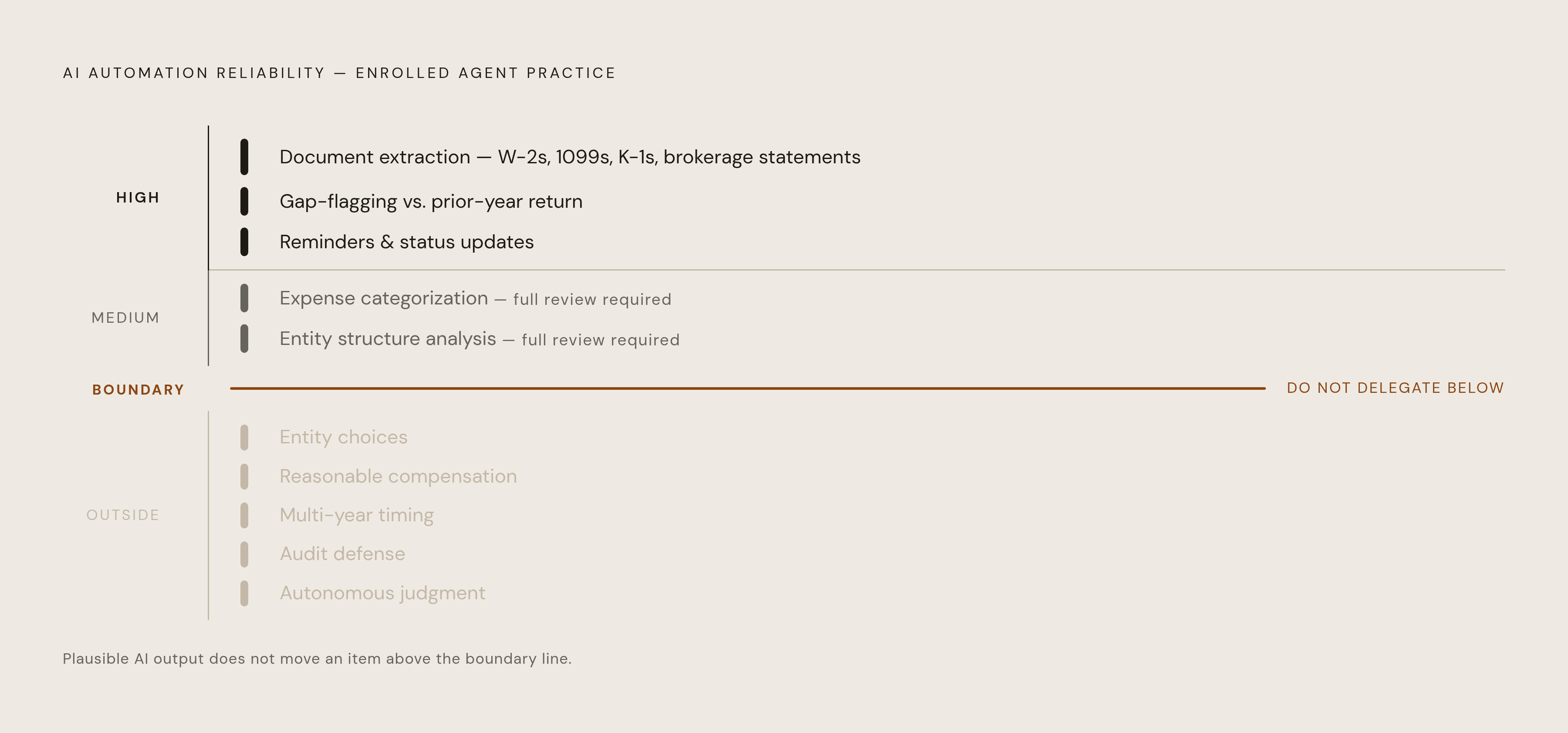
AI earns its place by taking over identifiable tasks rather than promising to perform the entire engagement. It can collect, sort, and name source documents, then extract data from W-2s, 1099s, K-1s, and brokerage statements. It can compare the current document set with the prior-year return and flag missing items before the client call. Reminders and status updates can also move out of the practitioner's memory and into an automated workflow. First-pass diagnostics flag exceptions for a person to check before sign-off.
Reliability should be assessed by task as practitioner guidance. Document extraction is highly reliable, but a person still needs to review brokerage basis. Expense categorization and entity structure analysis have medium reliability at best and need full review. Autonomous judgment involving entity choices, reasonable compensation, multi-year timing, or audit defense belongs outside the dependable automation boundary. The signing preparer remains responsible regardless of who or what produced the draft.
AI can search primary authority and synthesize a cited answer, leaving the EA to verify the citations and apply the conclusion. The Thomson Reuters 2025 Future of Professionals Report found that professionals predicted, without measured savings, that AI could save them five hours a week within the next year. Multi-entity modeling can also compare combinations across an S-corp, a rental, and a W-2 spouse, helping the practitioner evaluate the combined effects of strategies across returns.
Agentic AI carries these tasks through a sequence, collecting documents, flagging gaps, routing items, and updating the client queue. Juno's AI return review is a named development in the review layer. Silent errors can still slip through workflow automation and review assistance. Prior-year inference can import outdated facts without flagging the assumption, while ungrounded generation can fabricate authoritative-looking citations or figures. With no team backstop, a solo EA needs a stronger verification boundary.
How document intake automation converts wasted hours into recoverable margin
Intake offers the highest hours-per-return payoff because every return has documents to collect and organize. Chasing, sorting, naming, and entering documents take time on every return. Cutting that time leaves room for more work even when the number of returns stays the same.
The illustrative 400-return calculation shows the scale. If AI halves the assumed intake workload, approximately 133 hours become available again, equivalent to more than three full work weeks. The calculation divides the existing intake time in half and treats the eliminated half as recovered capacity. It is an illustrative scenario. Its usefulness is that it makes a small recurring task visible as an annual operating cost.
The next calculation depends on what happens to those hours. Time redirected to advisory creates potential revenue at the practitioner's advisory rate, but available hours do not become booked engagements by themselves. Keeping that time for recovery means fewer late-night document hunts and follow-up emails. A solo EA does not have to monetize every saved hour for automation to be worthwhile.
How the IRS OPR's June 2026 guidance changes what responsible AI use looks like for a solo EA
The IRS OPR's June 2026 guidance clarifies the professional boundary around these efficiencies. It creates no new rules and instead applies existing Circular 230 obligations to AI-generated content. Due diligence, competence, fee standards, written advice requirements, confidentiality, and supervisory procedures retain their force. Responsible adoption is therefore not a separate standard from responsible tax practice. It is the same standard applied to different tools.
Section 10.35 makes technological literacy part of competence. Practitioners must understand how their tools work, where they fail, and when their output is unsuitable for IRS submission. The silent errors described above are consequently compliance concerns as well as quality concerns. A solo EA remains responsible for supervising personal use of AI, even without employees. Reviewing citations and assumptions cannot be delegated to the same output being reviewed.
The OPR identified billing for manual labor or time not actually spent, and double-billing for AI-assisted work, as potential Section 10.27(a) violations depending on the facts. Value-based pricing fits advisory because it charges for outcomes. It aligns the commercial model with the service actually delivered while remaining subject to fee standards.
Confidentiality also extends to every tool in the stack. Uploading a client's prior-year return to a public AI platform can lead to liability under IRC Section 6713 and IRC Section 7216, even if nothing was disclosed outside the platform. Documenting the AI stack, review procedures, and billing rationale gives careful adopters a defensible record. The guidance makes those practices a professional distinction.
How Josh Youngblood and Alan Pinck show what the integrated model looks like in practice
Josh Youngblood, EA, of The Youngblood Group LLC in Dallas, Texas, illustrates a practice positioned around preparation, planning, and IRS representation. Representation is one of the offering’s specializations. That combination places preparation within a broader relationship in which the credential supports more than filing a return. Administrative automation creates room for that broader work.
Alan Pinck, EA, brings more than 35 years of tax preparation experience to a Silicon Valley practice specializing in individual and small business preparation and audit representation. He is the moderator of Tax Talk Today and a speaker at NAEA events and IRS National Tax Forums. His practice illustrates the value of long-term relationships grounded in trust and expertise. Those are precisely the capabilities that an AI-assisted operating model is intended to preserve.
Together, these examples clarify what the integrated model is for. Compliance is still part of the practice, but representation, planning, and relationships make more use of professional judgment. The examples show the service model that recovered hours can support. Practitioners can draw on their experience and use technology together when the tools handle work that does not call for their judgment.
What tools does a solo EA need to scale without hiring, rather than retrofit a generic stack?
A solo EA needs software built for professional preparation before looking at its AI features. The underlying preparer system must support PTIN and EFIN workflows, bulk e-file, multi-client return management, and representation tasks. Consumer products are not a substitute for paid-preparer software and lack the preparer signature block. Pay-per-return pricing works well for fewer returns, while unlimited licenses look better as the number of returns grows. The relevant cost is both the subscription and the work left undone.
The AI stack then needs three layers that handle extraction, assistance, and strategy. Extraction reads PDFs, photos, and brokerage statements and maps data to form fields, with the lowest review burden. Assistance answers tax questions with citations that the practitioner must verify. Strategy finds chances to plan across a client's entities and is especially useful for earning more from advisory. The IRS 2025–2026 Priority Guidance Plan contains 105 active projects, illustrating the breadth of the research surface.
Purpose-built tax software matters because the engagement runs through intake, extraction, compliance preparation, review, and representation. A generic workflow can leave the most expensive handoffs untouched. Among tax-specific options, Marble brings research, intake, analysis, and preparation into a shared client context. Its intake tools collect documents, handle extraction, and flag what is missing.
The practical selection test is to run the hardest question through the platform. S-corp reasonable compensation, multi-state nexus, or a K-1 with unusual basis can reveal whether a platform supplies specific primary authority or unsupported summaries. A plausible answer still needs to trace back to an IRC section, Treasury Regulation, or case law. Assistance with high-quality citations reduces review burden, while assistance with poor-quality citations relocates it.