Delegating Tax Review Work to Senior Staff
Mechanical review tasks eat reviewer time; strip them out before the work arrives.

By mid-March, the queue in front of every senior reviewer at a mid-sized firm looks the same: a stack of completed returns waiting for one person to look them over before anyone can sign. That queue, not the preparation work behind it, is what decides whether a firm hits its deadlines. A preparer builds a return from the documents a client sends in. A reviewer, usually a senior staffer or a manager, checks that return against those same documents and against the firm's own standards before it goes out the door. The two jobs look similar on an org chart, but they scale differently: a firm can bring on more preparers in a matter of weeks, while a reviewer takes years to develop and cannot be hired on short notice. That asymmetry is why a handful of experienced people end up standing between a much larger preparation staff and a filing deadline, and why most of the hours spent in that queue go to tie-out and completeness work rather than the judgment calls the role was built for.
What a senior reviewer does
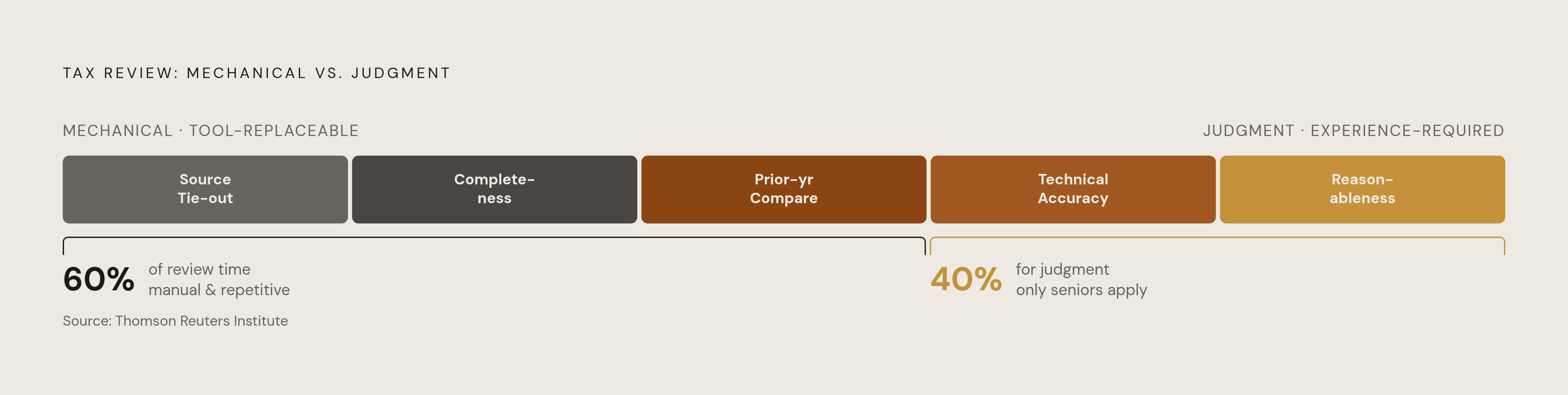
A thorough review of a tax return covers five distinct areas, and they are not interchangeable in terms of what they demand from the person doing them. Source-to-return tie-out is the first: every number on the return has to trace back to a document, a W-2, a 1099, a K-1 allocation, brokerage proceeds, mortgage interest, a charitable receipt, comparison work done line against line. Completeness is the second: checking whether documents that showed up in a prior year are missing this year, which is pattern-matching more than judgment. Prior-year comparison is the third, flagging swings in income or deductions and confirming that carryforwards moved correctly from one year's return to the next; part of this is mechanical, part of it calls for some interpretation. Technical accuracy is the fourth: the right forms, the right elections, and the right treatment of items like the qualified business income deduction or state apportionment can all be checked against a rule. Reasonableness is the fifth, and it's the one category that actually requires years in the chair: does this return make sense for this client, given everything the reviewer knows about their business and their history? That question can't be reduced to a checklist.
The conflation of these five tasks under a single job title is understandable. All five show up on the same return, often within the same hour of work, and a reviewer moves between them without a formal handoff. Entity returns, forms 1065, 1120, 1120-S, 1041, and 990, make the problem worse simply by volume: more documents, more schedules, more places for a figure to land wrong. More hours get spent on the mechanical layer before anyone reaches the reasonableness question. The Thomson Reuters Institute has found that tax professionals spend roughly 60% of their time on manual, repetitive work. That is time spent before judgment gets applied, not time spent applying it. A reviewer's most valuable contribution, the read on whether a position makes sense and holds up technically, is squeezed into whatever time is left after the comparison work is done.
Why the talent shortage makes the current model increasingly unsustainable
The review bottleneck is not a temporary staffing gap that a strong recruiting season will close. Accounting degree completions have been declining for years, and the resulting shortage of qualified professionals is projected to extend through at least 2029. The shortfall isn't confined to the partner or manager level. Firms are also struggling to find the mid-level tax professionals who would normally handle complex returns on their own, field client questions, and give reviewers a buffer before work reaches their desk. When that middle tier is thin, managers and partners end up pulled back into preparation work to cover the gap, which takes them away from the review, mentoring, and business development that only they can do.
Some relief is on the way, but not soon. The AICPA and NASBA boards approved a new CPA licensure pathway in May 2025 that allows a bachelor's degree plus two years of experience to qualify someone for licensure, a change aimed squarely at widening the pool of candidates. Accounting enrollment at four-year colleges and universities rose in spring 2026 for the third year running. Both are genuine signs that the pipeline is repairing itself. Neither does anything for a firm trying to get through this April. A pipeline fix measured in years can't resolve a shortage measured in weeks, and that mismatch is what makes restructuring the review process, rather than waiting for more reviewers to arrive, the only lever a firm actually controls right now.
Assigning More Work to Existing Senior Staff Makes the Bottleneck Worse
The instinct, when a queue backs up, is to push more of the surrounding work onto the people already in it. That instinct makes the bottleneck worse, because it treats the problem as one of volume when it is really one of structure. When responsibilities around a return aren't clearly defined, review work tends to expand rather than shrink: senior accountants end up doing cleanup that should have been caught earlier, managers spend time chasing status updates instead of reviewing substance, and work that should run through a repeatable process starts depending on ad hoc emails and hallway conversations instead.
Seasonal preparers add to this. Many of them don't know a given firm's documentation standards, what a particular reviewer expects to see flagged, when to escalate a question, or where the firm's quality bar sits. More clarification cycles, more rework, and longer reviews follow, canceling out whatever capacity the firm thought it was buying by adding preparers. Thomson Reuters has found that only 73% of firms rate the reallocation of lower-level work to existing credentialed staff as even "somewhat successful," and part of the reason is straightforward: credentialed staff don't find administrative tasks rewarding, so compliance with the new division of labor is spotty. A multi-office CPA firm offers a sharper version of the same lesson, though from the opposite direction. Rather than hiring five seasonal staff to absorb volume, the firm categorized its returns by preparation time, review requirements, and risk profile, then hired two experienced professionals six months earlier than usual and cross-trained the staff already on hand. That approach produced better coverage without the drag of onboarding five new people mid-season. The distinction that separates the two outcomes is simple: redistributing volume without redesigning the process around it adds friction, while redesigning the process first makes any later staffing decision more effective.
The structural fix: removing mechanical work before it reaches senior reviewers
Mechanical work needs to be stopped before it reaches a senior reviewer's calendar. Effective delegation means a return enters a senior reviewer's queue already stripped of its comparison and verification work, so the reviewer opens a list of flagged issues rather than a blank return and a stack of source documents.
Software can take over the first layer of that work: reading source documents, comparing them line by line against the draft return, and handing the reviewer a list of discrepancies with the supporting evidence attached. Review itself stays a human function. The reviewer still has to clear every flagged item and still has to sign the return; what changes is the starting point, not the responsibility. Platforms like Marble, which automate the matching of client documents against return figures and firm standards, can surface these mechanical findings so that senior reviewers spend their limited time on the reasonableness and technical judgment that actually calls for experience, rather than re-tracing a W-2 figure that a tool could trace just as reliably.
Standardized, written procedures for preparation and pre-review reinforce the same shift. When staff can follow the same documented process across engagements, less experienced team members can work with more independence and escalate to a senior reviewer only when something genuinely needs their judgment, instead of needing a reviewer's attention for routine questions. Segmenting clients by complexity is a related lever: complex or high-value engagements still warrant close senior-level oversight, but simpler individual returns can move through a standardized workflow with delegated preparation and a lighter review touch from the top. Firms have also started pruning the work that resists this kind of structuring. The Journal of Accountancy reported that firms are eliminating smaller legacy individual tax return filing work, and at least one firm bases its client-culling decisions in part on how many people in the practice actually have the skills to handle a given engagement. Work that's too specialized to delegate is work that's hard to scale, and cutting it preserves senior capacity for the work that can be structured for delegation.
Purpose-built tools tend to outperform general-purpose practice management software for this reason: the pre-review checklist, the document-matching logic, and the escalation rules all need to reflect how a tax engagement actually moves from intake to signature, not how a generic platform assumes work should flow. Marble is built on that same logic, automating the repetitive backend of a tax engagement, client intake, document review, completeness checks, so that what lands on a senior reviewer's desk arrives already organized and flagged.
What senior reviewers should be doing with the time the structure creates
Once mechanical work is intercepted before it reaches the senior desk, what's left is the work only an experienced reviewer can do: judging whether a position actually makes sense, anticipating where a return might draw audit attention, and giving a client advice they couldn't get by reading the return themselves. Compliance work is being commoditized. Technology can now complete basic compliance tasks in a fraction of the time a person needs. A firm's real differentiation comes from the strategic insight a generic practice can't offer. That insight is the reasonableness judgment, the planning opportunity buried inside a return, the technical call on a close question, and the ability to explain a tax implication to a client in terms they can actually act on.
Documentation is itself a form of judgment work, not an afterthought to it. Tax agencies now run audits that rely on analytics and cross-checks reaching far wider and deeper than before, and writing down why a position was taken, which facts support it, and which alternatives were weighed and rejected is a senior-level function that protects the client when questions arrive months or years later. The IRS Office of Professional Responsibility made the stakes of that function explicit in 2026, stating that practitioners carry full responsibility for any work produced with AI assistance and must exercise due diligence in verifying its accuracy. Senior review of AI-assisted output isn't a courtesy step a firm can skip; it's where professional accountability actually sits.
Circular 230 makes the same point from a different angle. Section 10.22 requires due diligence in preparing, approving, and filing a return, and permits reliance on someone else's work only if the practitioner has used reasonable care in engaging, supervising, training, and evaluating that person. A senior reviewer can delegate mechanical preparation. A senior reviewer cannot delegate accountability. Section 10.36 extends that further, requiring anyone with principal authority over a firm's tax practice to take reasonable steps to ensure the firm has procedures in place to promote compliance across everyone on staff, which makes the kind of structural redesign described here a regulatory responsibility, not just an operational preference. A senior reviewer spending time on reasonableness and forward-looking advice is also the reviewer a client is willing to pay more for and come back to year after year, and freeing that time is a decision about what kind of firm this is.