Offshore and Outsourced Tax Preparation for US CPA Firms
Growing firms can handle bigger caseloads without hiring by combining offshore prep and automation.
A solo tax practitioner or enrolled agent who wants to grow revenue without adding headcount has two real levers: offshore or outsourced preparation to absorb volume, and automation to cut the hours spent on intake, research, and documentation. Neither works well alone during busy season. Together, they let a one- or two-person practice handle a multi-state caseload that would otherwise require a hire, and this piece lays out what that looks like in practice, including where the two levers meet.
Offshore tax prep's shift from cost tactic to operating necessity
CPA firms are turning away clients. There's nobody on staff to do it. That is the operating reality driving more firms toward offshore and outsourced tax preparation, and it did not arise from a single bad hiring season. It's the output of a pipeline that has been shrinking for a decade. Firms feel the consequence directly: CPA-required roles now take roughly 73 days, about two and a half months, to fill, and many firms report turning away new clients simply because they lack the staff capacity to serve them.
But enrollment growth takes four to five years to turn into a working professional at a desk during filing season, so it does nothing to ease the capacity pressure firms face now, even as the pipeline shows signs of future growth. It's a structural response to a labor shortage that domestic hiring cannot solve on its own, and it's the operating model the rest of this guide examines in detail.
How offshore tax preparation works as an operational model
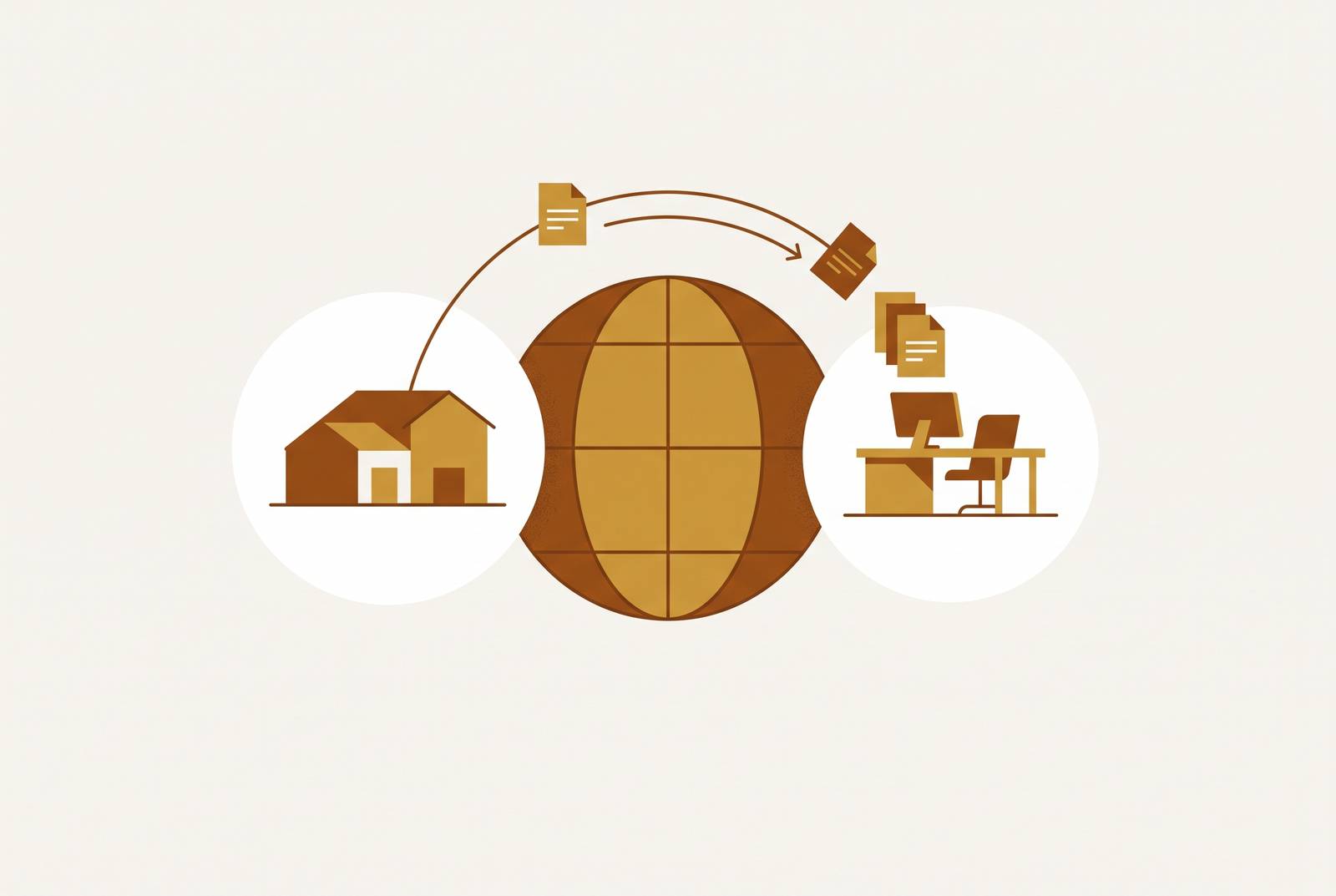
Offshore tax preparation follows a defined, repeatable pattern, not an improvised one. Client documents transfer through secure channels to qualified professionals working abroad. Those preparers build the return using the same US tax software a domestic preparer would use, under the same regulatory standards, and the finished return returns to a domestic CPA, who reviews and approves it before it reaches the client or the IRS. That review step is the structural anchor of the entire model, a point the later sections return to because firms that skip it undermine the arrangement's legitimacy.
The scope of work that moves offshore has expanded well past simple 1040 preparation. Offshore teams now routinely handle return preparation across return types, including 1120S, 1065, and 990 filings alongside federal and state 1040s, plus year-end reconciliation and workpaper documentation, tax projections and estimates, payroll tax filings, and 1099 preparation. Many also handle IRS response support, client onboarding paperwork, and sales tax filing, particularly for multi-state and e-commerce clients whose compliance burden has grown heavier than a solo practitioner can keep pace with alone.
People often treat the time-zone difference as a logistical inconvenience, but it works in the firm's favor. Each model has its own cost profile and its own level of integration, and that matters more once a firm starts comparing providers.
The cost structure of offshore tax preparation
The cost advantage of offshore tax preparation comes from a difference in labor markets, not a discount on the quality of the work. Firms save roughly forty to seventy percent when they compare it to staffing the same work domestically. A firm paying for a dedicated senior preparer handling multi-entity returns is not going to see the same savings as one paying per return for straightforward 1040 work.
What firms are actually avoiding by going offshore is not the preparer's salary alone. Scalability is itself a cost benefit, not merely a convenience. Firms can ramp offshore support up during the January-through-April filing window and draw it back down after, so there are no layoffs and no idle headcount through the slow months, and full-time domestic hiring cannot match that.
The alternative cost, meanwhile, keeps climbing. None of this makes the decision automatic. These savings carry legal strings, and the next section shows what a firm must do to keep an offshore arrangement from crossing into carelessness.
The legal framework governing offshore disclosure of client tax data
Sending a client's tax information offshore is legal under US law, conditional on meeting obligations under IRC Section 7216 that most firms do not fully satisfy on the first attempt. The IRS has recognized since at least 2006 that foreign outsourcing is not prohibited, provided the preparer obtains the client's consent and meets specific data safeguard requirements. That permission has always come with strings attached, and the strings are where firms most often stumble.
Section 7216 carries real teeth. Knowingly or recklessly disclosing a client's tax return information without proper consent is a criminal misdemeanor, carrying up to a year of imprisonment and a fine per violation. Its civil counterpart, IRC Section 6713, requires no intent at all: every wrongful disclosure carries a per-incident fine, capped at a set amount per calendar year. The taxpayer's Social Security Number has to be redacted or masked before any tax return information leaves the United States, unless the US preparer and the offshore preparer both maintain an adequate data protection safeguard and the client has separately consented to SSN disclosure. The consent itself must tell the client that their data will be processed outside the US, and that federal agencies may not be able to enforce US privacy laws against the offshore preparer.
One assumption trips up firms more than any other: that if the offshore preparer is a direct employee of the firm rather than a third-party contractor, no additional consent analysis is needed. That assumption is wrong. Getting the consent structure right is not a one-time checkbox a firm clears before launch. It has to hold up continuously, alongside a domestic review layer that actually functions, which is exactly where the data security obligations covered next come into play.
Data security obligations that apply regardless of where the work is done
Most tax professional data breaches hit firms that never sent a single file offshore. That fact reframes the entire security conversation: the real risk variable is not geography, but verification discipline. Under the FTC Safeguards Rule, a CPA firm is fully accountable for the security of a client's non-public personal information even when that data sits on a vendor's servers, whether that vendor is offshore or down the street. The FTC can impose civil penalties per violation, and if a breach originates with a vendor, the FTC looks to the firm itself for compliance failures, not only to the vendor that got breached.
The Safeguards Rule sets specific expectations for any vendor relationship. Security requirements belong in the engagement agreement as binding contractual terms, because informal assurances are not enough. And the relationship requires ongoing monitoring, not a single check performed at onboarding and never revisited.
The EY security incident is instructive here because it demonstrated that the weakest point in a firm's security chain is often a third-party platform. That risk applies just as much to a domestic vendor relationship as to an offshore one. Firms evaluating any provider should ask how it encrypts data in transit and at rest, how it shares files securely, what its disaster recovery documentation shows, and where client data physically resides. Those are the specific questions a firm needs answered before signing anything, which is the subject of the evaluation framework that follows.
Criteria for choosing an offshore or outsourced tax preparation provider
Choosing an offshore or outsourced tax preparation provider is a risk-management decision as much as it is a procurement one, and the criteria that matter have to be verifiable. On credentials, a firm should look for teams staffed with CPAs, Enrolled Agents, or Chartered Accountants specifically trained in US tax law, not simply holders of a general accounting qualification, and those credentials should be checked independently rather than accepted as stated: CPAverify and the IRS's publicly available list of Enrolled Agents are the standard tools for that verification. The provider should also be able to demonstrate familiarity with US GAAP, IRS regulations, state-specific requirements, and multi-jurisdictional returns, since federal 1040 competence alone does not cover the range of work most firms now send offshore.
On security, you can turn the standards from the previous section directly into questions to ask before you sign anything. A provider should hold current SOC 2 Type II and ISO 27001 certifications, so ask to see the actual reports, not a summary slide. On the consent process, you need to know how the provider structures offshore consent, whether it keeps disclosure consent and use consent as genuinely separate documents, and how it handles Social Security Numbers before any data leaves the United States.
Turnaround time and scalability deserve the same scrutiny. Leading providers typically offer a 24-to-72-hour turnaround during peak season for standard returns, so confirm that commitment as an actual service-level agreement. Engagement model flexibility matters too: per-return, hourly, and dedicated FTE arrangements suit different firm sizes and workload patterns, and a firm should confirm the provider can scale rapidly during the January-to-April filing window without the quality of the work degrading under the added volume. Workflow integration is where a lot of friction either disappears or compounds: compatibility with the firm's existing tax software, whether that is Drake, UltraTax, Lacerte, or a cloud-hosted platform, reduces the friction in every handoff, and real-time progress visibility through task-tracking tools lets a firm monitor status without having to chase updates manually. And if a firm's clients decline offshore consent, it can still turn to domestic outsourcing arrangements, including staffing models that place workers in US-based locations, so it sidesteps the offshore disclosure requirements entirely while still addressing the underlying capacity problem.
Where offshore outsourcing fits into a firm's broader workflow
Offshore tax preparation works best as one layer in a larger operational system that increasingly includes automation tools that change which tasks need a human. Firms that redirect their internal teams away from routine preparation and toward review, advisory, and client-facing work report launching new service lines, Client Advisory Services being the most common, that were simply impossible to staff before offshore capacity freed up that time.
Automation is already reshaping the preparation layer itself. Thomson Reuters' Ready to Review applies agentic AI to automate an unprecedented share of the 1040 tax process, aiming to turn preparers into reviewers. KPMG projects that agentic AI will bring material workforce efficiency gains and will cut operational costs within the next few years. If AI sufficiently automates the preparation work that offshore teams currently handle, the economic rationale for offshore staffing narrows. The IRS has not issued formal guidance approving AI-prepared returns, and significant questions about practitioner oversight remain unresolved, but the direction of travel is clear, so firms planning offshore arrangements today should plan with it in mind.
Purpose-built platforms are already narrowing the gap between offshore labor and automated preparation. Platforms like Marble that automate the backend of tax engagements, including client intake, document review, and compliance checks, reduce the volume of manual triage work that currently flows either to internal staff or to offshore teams, freeing practitioners for the advisory work that neither offshore preparation nor AI currently delivers well on its own. The practical implication for a firm weighing an offshore arrangement today is a choice between continuing to staff preparation work with human labor, onshore, offshore, or some blend of the two, and building toward a workflow where automation absorbs the routine layer while human expertise, wherever it sits, concentrates on review, judgment, and advisory work.
Operational considerations firms underestimate before they commit
Firms that struggle with offshore tax preparation are almost always missing one of three things: a working consent structure, a verifiable provider, or a genuine domestic review layer, and the review layer is the one most commonly skipped. That step is not optional. Offshore-prepared returns require a US-licensed CPA to review and approve the work before filing, and firms that treat this as a formality rather than a substantive check undermine the entire compliance rationale the arrangement depends on.
Communication and process design take more initial investment than most firms expect going in. Client communication remains the firm's responsibility, not the provider's: clients need to understand what offshore consent actually means before they sign it, and it is the firm's own relationship with the client, not a vendor's marketing language, that makes that conversation credible.
Ongoing monitoring of the vendor relationship is required under the FTC Safeguards Rule, and it's good practice independent of any regulatory requirement. Security certifications expire, staff turns over, and a provider that was SOC 2 compliant at onboarding may not still be compliant twelve months later without a re-check. Firms that treat offshore outsourcing as a quick seasonal patch consistently report the worst outcomes, but if firms integrate offshore teams into standard workflows, build structured feedback loops, and maintain a genuine domestic review layer, they report faster turnaround and fewer errors over time. The conditions under which offshore outsourcing works well are fully knowable, and they are achievable for any firm willing to build the consent structure, the vendor verification process, and the review layer before the busy season arrives, not during it.