Earnout Structures in Tax Firm Acquisitions
Earnouts tie tax firm valuations to actual client retention after closing.

Tax firm acquisitions have a valuation problem that revenue multiples and EBITDA models were never built to solve. What changes hands is a set of client relationships that may or may not survive the sale, not equipment, intellectual property, or a product line, and no standard M&A tool can tell either side, at closing, whether they will.
The valuation problem in tax firm acquisitions
A client relationship carries no title. It exists because a person trusted a specific practitioner, often across years of tax seasons, phone calls, and judgment calls made on the client's behalf. A buyer can read the financials, check the billing history, and go through the client list line by line. None of that work answers the one question that actually set the right price for the deal: will those clients stay once the founding partner is gone?
That question can't be settled before closing. It can only be observed afterward, as clients respond to a new owner, new staff, maybe new pricing, maybe a new portal they're asked to log into for the first time. The seller tends to believe retention will be high, because the seller knows these relationships and trusts their durability. The buyer, carrying the downside if that belief turns out wrong, discounts it. Both positions are reasonable. That gap makes tax and accounting firm deals different from a typical private M&A transaction: the disagreement isn't over growth assumptions or market multiples, it's over whether the core asset survives the transaction.
What an earnout is built to absorb
An earnout takes the part of the price the two sides can't agree on at signing and ties it to what actually happens after closing. The purchase agreement sets a metric, a measurement window, and a formula, and the business itself answers the question neither side could answer on paper.
The structure does two things at once. It protects the buyer from overpaying for a client base that doesn't stick around, and it gives the seller a route to a headline price higher than the buyer would otherwise sign off on, plus a share of whatever upside appears after the deal closes. Earnout periods typically run one to three years, timed to however long it takes to show whether the performance being bought is durable. None of this is a novelty: earnouts appear in roughly a third of private M&A deals overall, and in industries driven by milestones, like biopharma and medical devices, they appear in well over half. In tax firm deals, that one-to-three-year window lines up almost exactly with the client retention cycle. You get enough time to see whether clients come back next season, refer someone new, and stay put once the transition dust settles.
Building client retention into a tax firm earnout formula
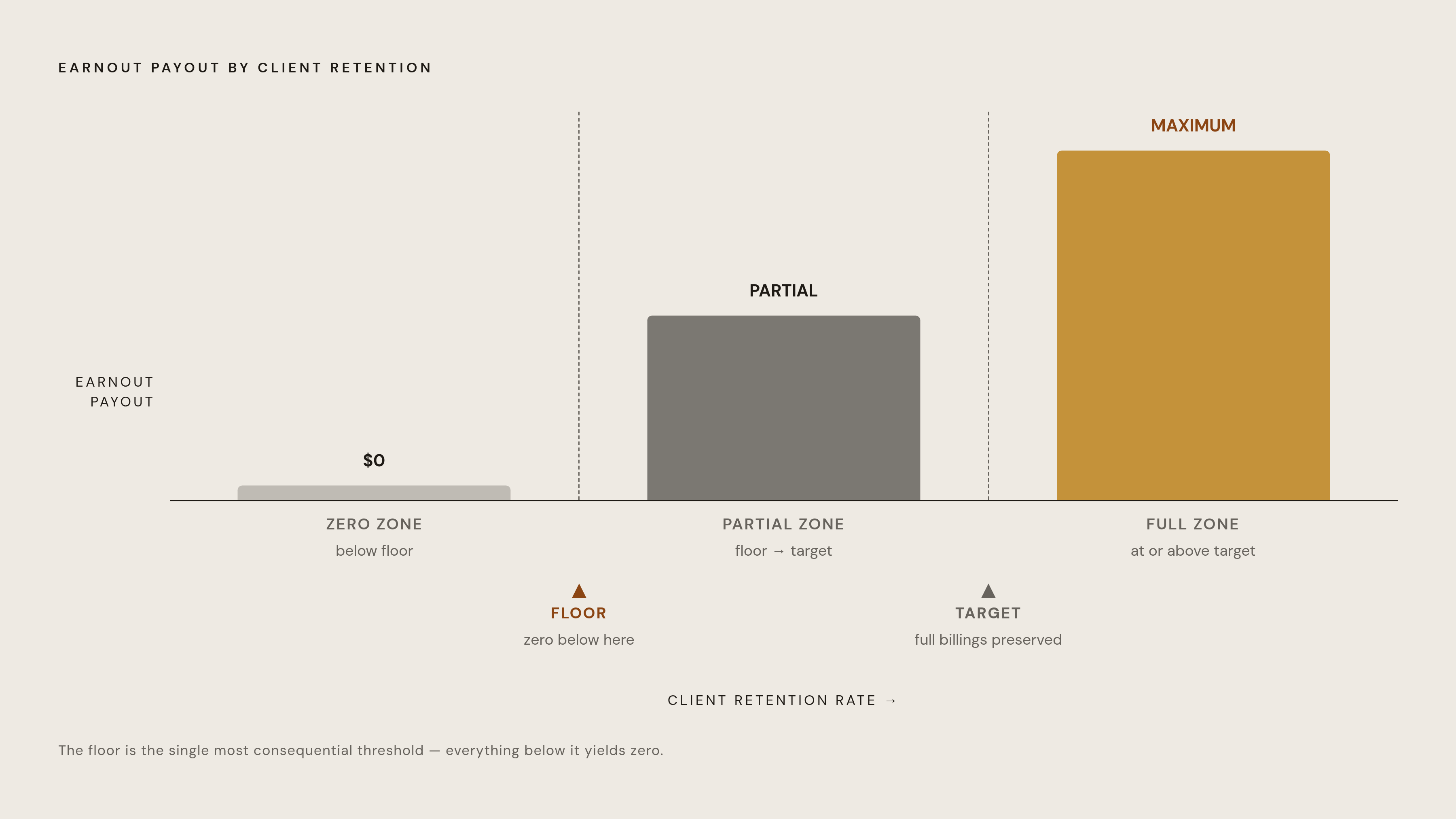
Because the asset actually at risk is the client relationship, client retention rate, not EBITDA and not gross margin, is the number that most directly measures what the buyer is paying for. EBITDA is easy to manipulate after closing without anyone acting in bad faith: management fees, overhead allocation, timing of expenses, and revenue recognition choices can all shift the number simply because the buyer now runs the books. A revenue-based earnout is somewhat cleaner, but it still moves with pricing changes, client mix, and billing timing, and the buyer controls all of that once the ink is dry. Retained billings, the portion of the acquired client base still generating fees under the new owner, shows directly whether the relationship transferred.
Consider a simple three-tier structure built around a retention floor, a midpoint target, and a cap. Below the floor, meaning only a modest share of acquired billings retained at the end of year one, the seller receives nothing from that tranche of the earnout. Above a target ceiling, meaning retention at or near full preservation of the acquired billings, the seller collects the maximum earnout payment for that period.
Getting that structure right takes more than picking thresholds. The agreement has to define which clients count toward the calculation, whether retention means renewal of an engagement, a minimum billing threshold, or both, and how to treat a referral from an existing client versus an original client on the acquired list. It also has to say what happens when a client leaves because the buyer changed pricing or the service model, since that's a loss the seller shouldn't be on the hook for. The formula needs a stated maximum payment, each threshold along the way, the measurement period for each one, and the date payment is due, along with a clear answer on whether missing a threshold means zero payment, a partial payment, or something on a sliding scale. One of the thornier boundary questions is what happens to a client who follows the selling partner to a new firm. Whether that counts as attrition caused by the seller's own conduct, or simply a transition that didn't take, determines who absorbs that loss, and the agreement has to settle it in advance rather than leave it for later.
The control problem: why sellers carry the risk of a business they no longer run
Every earnout in a tax firm deal runs into the same structural tension: the seller's payout depends on how a business performs, but the buyer is the one running it. Before closing, the seller controls pricing, staffing, client communication, and how the books get kept. After closing, those decisions generally belong to the buyer, and in a tax practice, nearly all of them touch retention directly. Whether fees go up, whether the staff clients recognize stay on, whether the buyer swaps out the software clients use to upload documents, whether response times slip during a busy season while systems are still being merged, each is a normal post-closing business decision that also moves the number the earnout is measuring.
None of this makes the buyer's choices improper. A new owner raising fees to match market rates, or replacing underperforming staff, or migrating clients to a new portal, is doing what any owner would do. But each of those choices raises the odds of client attrition that the seller is contractually exposed to without having any say in it. The standard legal response is a covenant requiring the business to be run in good faith, or "consistent with past practices," during the earnout period. These covenants are difficult to enforce, since a court asked to apply one has to work out whether a given client left because of something the buyer did, something the seller misrepresented, or something neither party controlled, like a client's death or a business closing its doors. Sellers can offset some of that exposure with audit rights, meaning access to the financials and records needed to check the buyer's earnout math, which is a basic protection rather than an aggressive demand. An acceleration clause helps too: it requires the buyer to pay out the full earnout immediately if the practice gets sold again or materially restructured before the measurement period ends, so a buyer can't exit the deal early and leave the seller's payout stranded.
The tax treatment of earnout payments
How an earnout payment gets taxed isn't automatic. It depends on how the deal is structured, how the payments are classified, and which provisions the agreement actually invokes, and a wrong answer can turn what should be capital gain into ordinary income, or trigger an acceleration nobody planned for.
Start with the seller's side. For most asset and stock sales involving deferred, contingent payments, the installment sale rules let the seller recognize gain as each payment comes in rather than all at once at closing. That spreads the tax burden across the earnout period instead of front-loading it in the year of sale. But Section 453 treatment isn't automatic: the agreement has to be structured to qualify, and payments that come in fixed rather than contingent amounts can end up treated differently. The sharper trap is recharacterization. If any part of the earnout depends on the seller continuing to provide services after closing, the IRS can treat that portion as compensation rather than purchase price, so ordinary income tax rates and payroll taxes apply instead of capital gains treatment. Picture a seller who agrees to stay on for two years to help with client transition, billed informally as part of making the earnout work. If the agreement doesn't draw a clear line between that transition support and actual services rendered for pay, the IRS draws the line itself, and it tends to draw it against the seller.
The buyer's side carries its own cost. There's no immediate step-up in tax basis for the portion of the price tied to the earnout until the contingency resolves, so a buyer counting on the depreciation benefit of a full basis step-up at closing doesn't get it right away. Under the residual method, future additions to basis from earnout payments get allocated to goodwill and other Section 197 intangibles, which have to be amortized over 15 years rather than recovered quickly. That's a real cost, and it tends to weigh more heavily on buyers who sit in high marginal tax brackets, since the tax drag from deferred basis can outweigh whatever valuation protection the earnout provides for them. A buyer's effective marginal tax rate belongs in the earnout negotiation itself, worked out at the table rather than afterward with an accountant. So if a buyer offers a higher fixed price instead of an earnout, they may simply be making a rational tax calculation, not conceding ground at the table.
Where earnout disputes concentrate in tax firm deals
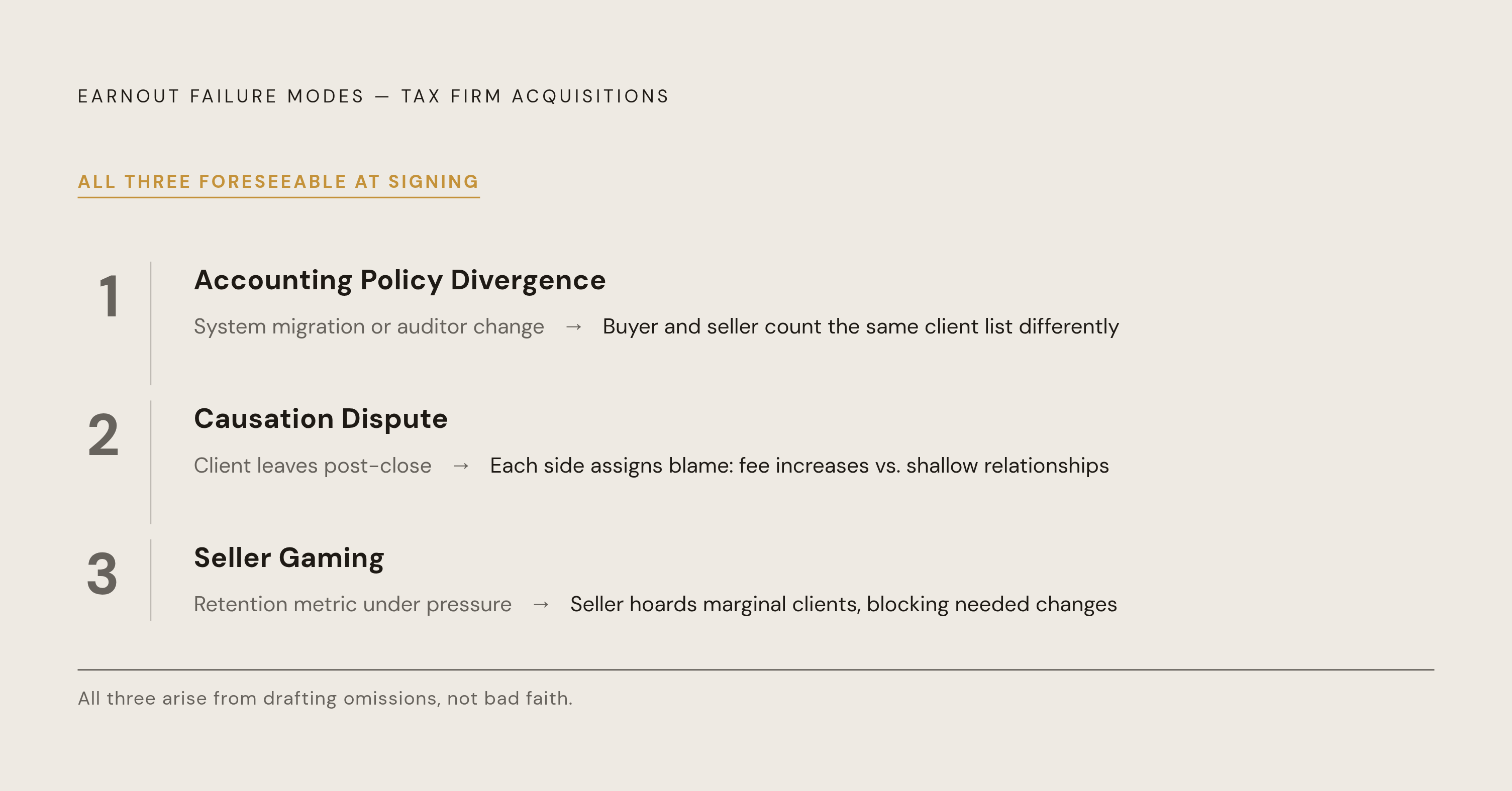
Disputes over tax firm earnouts tend to cluster around three failure modes, and each one is foreseeable at the time the agreement is signed. Most of the litigation that follows is a drafting failure rather than a sign of bad faith on either side.
The first is accounting policy divergence. A buyer's post-closing accounting approach often differs from what the seller used before the sale, particularly after a system migration or a change of auditor, so a retention metric calculated on the seller's old basis and the buyer's new basis can produce two different numbers from the exact same client list. The fix is to anchor the earnout definition to a specific financial statement line item, spell out every permitted addition and subtraction, and test the formula against the firm's historical financials and a sample post-closing period before anyone signs.
The second is causation disputes. When clients leave, both sides tend to blame the other: the seller says the buyer raised fees and drove people off, the buyer says the relationships were never as deep as represented. Sorting out causation after the fact is hard, since market conditions, buyer decisions, and seller misrepresentation can all produce the identical outcome, a client walking away, and the agreement needs to assign that risk in advance rather than leave a court to guess at motive later.
The third cuts the other way: sellers chasing the retention number itself. A seller paid on retention has an incentive to hold onto marginal clients rather than help the buyer make changes, like a fee adjustment, that the practice genuinely needs to stay viable long-term. Building in a dispute resolution process, whether binding arbitration or review by a neutral CPA, keeps these disagreements out of court, where litigating an earnout calculation is slow and expensive for both sides. The value of a well-built mechanism shows up in AM Buyer LLC v. Argosy Investment Partners IV, L.P., a Delaware case in which the purchase agreement required factual disputes over the earnout to go to an independent accountant whose findings were final, conclusive, and binding "other than for fraud or clear and manifest error." The court upheld that mechanism and declined to relitigate the accountant's conclusions. Vague drafting doesn't buy either side flexibility; it moves the fight to arbitration, where both sides usually end up with less leverage and a bigger bill.
The case against earnouts in CPA firm sales
There's a credible objection to using earnouts in CPA firm sales at all, and it deserves a straight answer rather than a dismissal. The argument runs like this: an earnout is meant to protect the client relationships the buyer is paying for, but if it's managed poorly, it can create a long, contested stretch of time that damages those same relationships more than a clean sale would have.
The case has real force. Client and staff retention after a sale is driven mostly by the quality of the new owner's management, the continuity of service, and how pricing gets handled, not by how long the seller physically sticks around. A seller who picked the right buyer and planned the transition carefully has, in a real sense, already done the work an earnout is designed to reward. And there's a specific version of the risk in tax firm deals: when a seller stays involved under an earnout for longer than the clients or staff actually need, tension between seller and buyer over who's really running the practice tends to surface, and clients notice friction between two owners faster than they notice a changed email signature or a new office layout. The objection doesn't argue that retention is unimportant. It argues that the earnout mechanism, if stretched past the point the transition requires, can create the very instability it was built to prevent. That is why the length of the earnout period and the clarity of the control arrangement matter as much as the retention formula itself.