Preparing a Tax Practice for Sale Over Three to Five Years
Build recurring revenue and owner independence over years to command top dollar when you sell.

Most tax practice owners treat a sale the way they treat filing an extension: something to think about when the deadline is close. The instinct is to keep running the practice as it always has run, wait until retirement feels right, then call a broker and see what the market offers. That instinct hurts you the most, because a buyer's offer reflects years of operational choices you made long before any conversation about selling began. Selling a tax practice for top dollar is a multi-year operational project, not a transaction event, and the gap between what owners expect their firm is worth and what buyers actually pay is almost always explained by the preparation time they didn't take. The buyer pool has changed in ways that make this gap wider than it used to be: private equity-backed platforms and roll-up consolidators now dominate the high-multiple end of the market, and they run disciplined diligence well before any letter of intent, surfacing every process gap a firm has before an offer ever gets made.
How PE-backed buyers changed what "market ready" means
Private equity's entrance into accounting M&A has reset the valuation criteria every seller now faces, whether or not that seller ever plans to sign with a PE-backed buyer, because PE-set standards are now the reference point the rest of the market measures against. EisnerAmper sold a stake to TowerBrook Capital Partners in August 2021, and Citrin Cooperman followed roughly three months later with a deal backed by New Mountain Capital. By the time CT Acquisitions updated its guide in April 2026, more than 27 PE-backed CPA platforms were actively buying. Transaction volume tells the same story from a different angle: CPA Trendlines and the Cornerstone PE Deal Tracker recorded 22 PE-backed accounting transactions in 2023, and volume has risen steeply every year since, to the point that January 2026 alone produced more transactions than many full prior years combined.
This shift changed the math, not just the cast of buyers. The old world of practice sales ran on revenue multiples and a modest multiple of seller's discretionary earnings, the kind of deal you'd see between a retiring sole practitioner and a neighboring firm. The PE-platform world runs on multiples of EBITDA at scale, so the profile a firm builds over years decides which pricing corridor it can enter. CT Acquisitions sets out the thresholds that govern this: a firm whose EBITDA falls below the entry band gets treated as an add-on, priced at broker-tier multiples regardless of how well it runs. A firm above that band enters a competitive, platform-quality process, and at higher EBITDA levels still, a firm becomes attractive to a Top 25 PE-backed firm as a bolt-on, or qualifies as a platform candidate in its own right.
If you own attest revenue, meaning audit or assurance work tied to a licensed CPA entity, you need to know one structural fact before you go to market. Most states require a licensed CPA firm to stay majority-owned by CPAs, so private equity acquires only part of the business. Instead, PE acquires the non-attest side, the tax compliance, advisory, and consulting revenue, and connects it to the licensed attest entity through a long-term Administrative Services Agreement. This structure, known as the Alternative Practice Structure, underlies every PE deal in the space, and a seller who doesn't understand it going in will misjudge both the process and the price.
The four-lever sequence that determines the final multiple
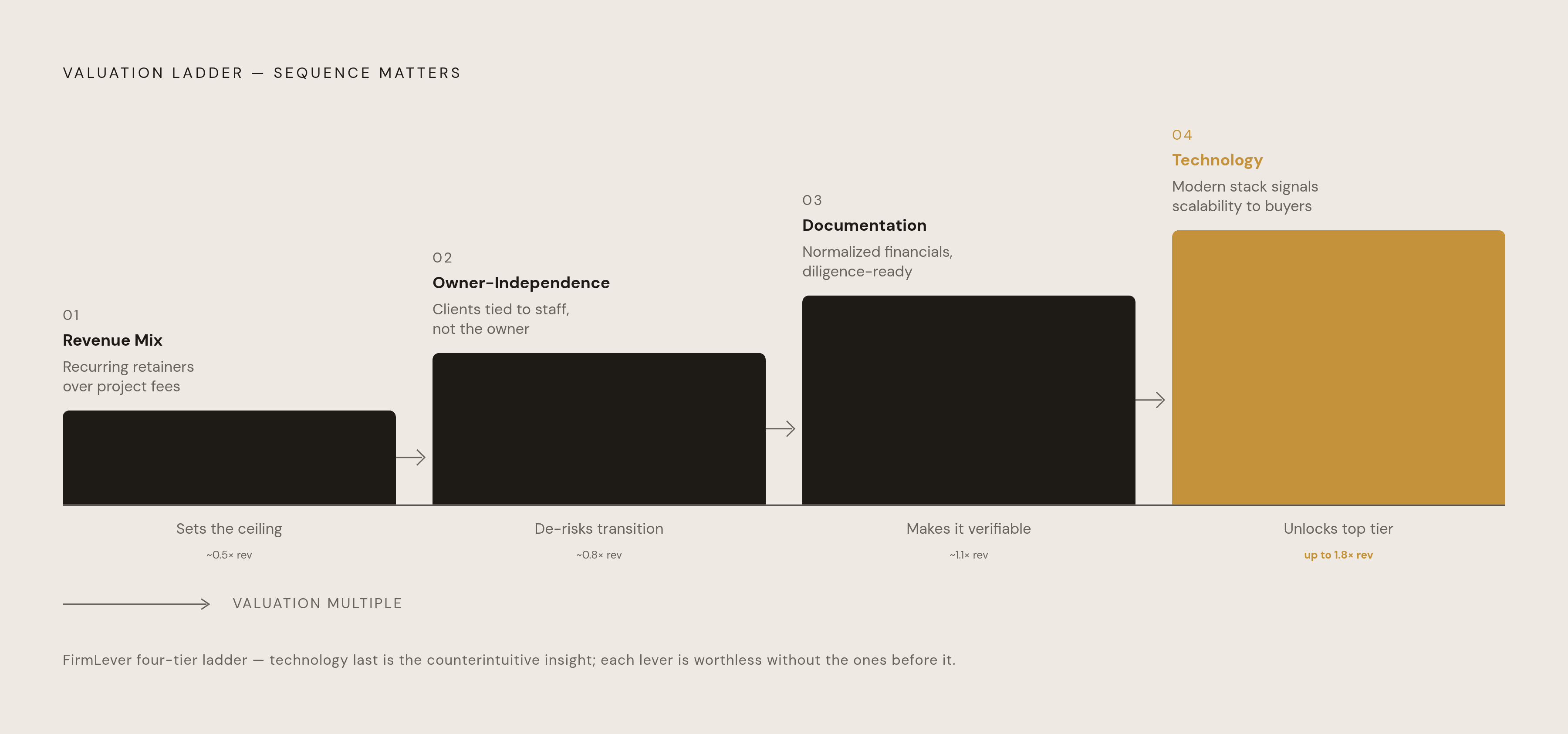
Four levers move the final multiple a tax practice commands: revenue mix, owner-independence, documentation, and technology modernization. Adstra Equity's 2026 checklist states the sequence: financial cleanup comes first, documentation comes second, buyer selection comes third, and the value drivers behind all of it get built over years, not assembled the week before a data room opens.
The order matters because each lever makes the next one credible. Revenue mix comes first because it sets the ceiling on what multiple is even possible. If a firm's income is concentrated in annual, project-based tax prep, it can't defend a recurring-revenue multiple no matter how clean its books look. Owner-independence comes second, because shifting revenue mix toward recurring work means nothing to a buyer if the client relationships behind that revenue still run through the owner personally and would walk out the door with the owner. Documentation comes third, because it's the mechanism that turns operational reality into something a buyer's diligence team can verify and a lender can underwrite. Technology modernization comes last, because a modern software stack bolted onto a broken revenue model and an owner-dependent client base adds cost without adding value, while that same stack, installed on top of a firm that has already fixed the first three levers, signals real scalability to a buyer. FirmLever's four-tier valuation ladder maps directly onto this progression, moving a firm from partner-dependent, to hybrid, to team-centric, to cloud-native specialist, with the top tier reaching multiples as high as 1.8x revenue.
Years five through three: auditing revenue mix and beginning the shift to recurring income
The earliest window of preparation starts with a revenue mix audit, because recurring revenue is the single largest driver of where a firm's valuation corridor is. Adstra Equity prescribes the method precisely: pull three years of fee revenue and sort every dollar into one of two categories. Recurring revenue includes monthly retainers, ongoing bookkeeping, client accounting services (CAS) subscriptions, and outsourced-CFO engagements. Project-based revenue includes annual tax prep and one-time engagements. When you measure that split across three full years, it tells you more about future pricing than any single year's profit can.
CT Acquisitions sets the benchmark buyers look for: a firm whose revenue runs predominantly through annual tax-compliance renewals combined with monthly CAS engagements is positioned for a platform-quality competitive process. Buyers pay a premium for monthly subscription models over hourly billing because a subscription guarantees future cash flow in a way that hourly billing never can, and FirmLever identifies recurring revenue as the first of its key valuation drivers for exactly that reason.
Revenue mix alone doesn't settle the question. A book that is 60% recurring but concentrated in one or two anchor clients creates the same anxiety for a buyer as a project-heavy book does, because losing either of those clients post-sale would gut the numbers a buyer underwrote. Any revenue mix audit needs to flag concentration risk alongside the recurring-versus-project split, and it can't treat them as separate problems.
The audit should also separate out revenue that will not survive a sale. Some portion of any practice's book runs on personal referral relationships tied to the owner, clients who came in because they know the owner personally and who may well leave with the owner regardless of how the deal is structured. Adstra Equity's checklist calls for identifying that revenue specifically, so it can either be transitioned to another point of contact within the firm over the preparation window, or stripped out of the normalized revenue base a buyer will eventually price against.
None of this work happens quickly, and that's the entire argument for starting five years out rather than three. Adding CAS engagements, advisory retainers, or outsourced-CFO work to a client base that has only ever bought annual compliance service takes multiple tax seasons of client education and service redesign. Clients who have used a firm for one thing for a decade don't adopt a new service line in a single conversation. The firm's client demographics matter here as well: FirmLever notes that a book weighted toward aging retirees is worth less to a buyer than a book of growing business owners, because the retiree book shrinks on its own over time while the business-owner book has room to expand. Fixing that imbalance is slow work, and the early phase of the preparation window is the only phase with enough runway to do it.
Years five through three: reducing owner dependency before clients become personal relationships
Work that only the owner can perform is worth far less to a buyer than the same work running through documented processes and named staff, and you need years, not the weeks before a closing, to build that second layer of coverage. Shifting revenue toward recurring advisory and CAS work only raises the multiple if a buyer can actually retain those relationships once the owner is gone. A firm that converts a substantial share of its book to recurring revenue, run entirely by an owner who personally handles every renewal conversation, has only moved the risk, not removed it.
Adstra Equity's checklist prescribes a direct exercise for this: map every key client relationship, every renewal conversation, and every technical review to a specific, named team member, not to the owner by default. Then build real second-chair coverage behind each of those names, so that a client's primary point of contact has a documented backup who already knows the account before any transition happens.
Staff retention runs alongside this lever and can't be separated from it. Adstra Equity's due-diligence document list calls for an employee roster that includes titles, tenure, compensation, and non-compete or non-solicit status for each staff member. If a staff member has no non-compete in place, buyers price that risk into any offer, because a buyer who underwrites a team-centric multiple needs to know the team stays intact after closing. FirmLever lists team quality, specifically a strong second-tier management layer, as a key valuation driver standing alongside recurring revenue, and lists staff retention, a capable team that agrees to stay on post-sale, as a separate driver in its own right.
Technology helps make this transition real rather than aspirational. When you automate routine intake, document review, and compliance workflows with tools built for tax practitioners, you free up the owner's day from work that staff or software can just as easily handle. That matters because it frees you to hand off high-value client relationships to team members on purpose, during the preparation window, rather than hoarding those relationships out of habit or necessity until the week a deal closes. An owner who has spent years delegating routine work walks into a sale with a team that already runs the firm day to day, which is the exact condition a buyer is trying to confirm exists before they'll pay for it.
Years three through two: cleaning up financials and building the documentation a buyer's diligence team expects
When you have clean, normalized financials and organized operational records, a buyer can act on years of preparation. A firm that has genuinely fixed its revenue mix and reduced owner dependency but skipped this step still negotiates from weakness, because none of that operational progress is verifiable without the paperwork behind it.
Adstra Equity states the core principle directly: the number a buyer multiplies is the normalized figure on the tax return. The most consequential adjustment in that normalization is the partner-compensation scrape: it replaces the owner's actual draws with what it would cost to hire a qualified non-owner manager to do the same job. Tax returns are built to minimize taxable income, not to represent what a firm would cost to run without its owner in the building, and a buyer's model has to correct for that difference before any multiple gets applied.
Adstra Equity's checklist lists several other adjustments that round out the normalization work. One-time or non-recurring costs, litigation expenses or relocation costs among them, get added back because they reflect ongoing earning power, not just a single bad year. Related-party rent means any lease between the firm and an entity the owner also controls, and it gets restated to market rate rather than whatever below-market or above-market figure the owner set for tax reasons. If personal or discretionary expenses run through the firm, they get removed from the earnings base. Revenue that will not survive the sale, the same personal-referral relationships flagged during the revenue mix audit, gets identified again here and excluded from the normalized figure. Every one of these adjustments needs supporting documentation, because if a buyer's diligence team can't verify an adjustment, they challenge or drop it, and a dropped adjustment lowers the number the final multiple gets applied to.