Moving Compliance Clients Into Ongoing Advisory Retainers
Compliance clients hold untapped advisory revenue if firms pitch extension rather than replacement.

CAS practices reported median growth of 17% in 2023, against a firm-wide median of 6.7% in net client fee growth. That ten-point gap is the market compliance-only firms are handing to whoever moves first, and in a profession this slow to change, moving first doesn't require moving fast. It requires moving.
The Future Ready Accountant report found advisory went from something 52% of firms called a key service to 63% just a year later. A reallocation that size inside a single fiscal cycle means the change has stopped being aspirational.
None of this calls for a new client base. Every compliance client already comes with tax history on file, an entity structure fully documented, and a call scheduled around filing season without anyone chasing them for it. That combination, trust plus data, is the asset sitting unused. Treating compliance as the end of the relationship instead of the start of one keeps growth from appearing. Firms keep making that choice by default, not by decision, which is worse.
Compliance clients as a better starting pool than cold advisory prospects
Compliance answers a backward-looking question: what happened, and what's owed because of it. Advisory answers a forward one: what should the client do next, given cash position, entity structure, hiring plans. Different services, same underlying financial picture, and a firm that's filed a client's returns for three or four seasons already has that picture built. Cold prospects arrive with none of it. They come with skepticism a firm has to spend months dismantling before the client hands over anything useful.
That's the real cost of chasing cold advisory leads, and it's not the marketing spend. It's the year of credibility-building most firms underprice or ignore. A compliance client has already cleared that phase. The pitch only asks them to extend a belief they already hold.
There's a retention effect layered on top of that trust. Firms offering advisory alongside compliance see structurally lower client turnover than firms that stop at the return. The mechanism isn't complicated: a client who hears from the firm once a year treats it as overhead, a bill that shows up every April. A client in an ongoing advisory conversation treats the same firm as a strategic partner, and partners are harder to fire than vendors.
Identifying which compliance clients are ready for advisory now
Not every compliance client belongs in the pipeline on the same clock, and treating them as if they do is how conversion efforts stall out. Prioritization has to happen before the pitch, not during it.
A handful of signals carry most of the weight. Clients who ask questions outside the compliance scope ("What should I do with this cash?" or "Is now the time to buy equipment?") are already reaching for advisory without knowing what to call it. Clients with recurring complexity, multiple entities, pass-through income, real estate, payroll, are ones where planning compounds year over year instead of resetting every January. Revenue stage matters too: businesses in the $500K to $2M range have often outgrown once-a-year financial management without the internal resources to fully close that gap.
Watch for a transition on the horizon, such as an exit, a partnership change, an expansion, or a hire that reshapes the org chart. These are the moments where timing and structure decisions carry real dollar consequences, and a client mid-transition has an urgent reason to want ongoing guidance rather than an annual check-in. Some clients are already handing over the answer. They call between filings with ad hoc questions, consuming advisory informally, for free, with no retainer attached to any of it.
Deprioritize the single-filer W-2 client with no business complexity, the client who fights every fee increase, and the client whose situation stays genuinely static year over year. None of that is a judgment on the client. It's a judgment on where conversion effort actually pays off.
The screening itself is not complicated. Pull the last two years of compliance files. Flag every client who triggered one of the signals above. That flagged list is the pipeline, built entirely from data already sitting in the firm's own system.
Defining the scope of an ongoing advisory retainer so it doesn't collapse into free consulting
The most common failure mode is the vague retainer: "on-call support," unscoped, billed flat, no named deliverable attached anywhere. Clients cancel these because they can't see what they're paying for. Firms lose margin on them because there's no boundary around what "on-call" means in practice. Retainers with named deliverables give clients a concrete reason to continue. Retainers described only as general availability leave clients without a clear answer to what they're paying for each month.
Four models cover most of what's actually in use, and picking the wrong one for the client in front of you is where scope creep starts. Pay-for-work charges a recurring fee for a defined package or hour bank, and reads closest to how compliance already gets billed, which makes it the easiest entry point for a client new to retainers. Pay-for-access charges for priority response and fast turnaround as issues surface, suited to clients whose needs are genuinely unpredictable. The advisory retainer proper, roadmaps, operating reviews, risk conversations, is priced on judgment rather than deliverables, and it demands the deepest trust of the four because the client is paying for thinking, not output. A hybrid model blends a baseline of access with a defined deliverable set and explicit overage rules, and it tends to fit small business clients best, since their needs shift with the season.
Scope discipline functions as a financial control, not a courtesy. Revenue leakage in professional services climbed to 5.3% in 2024, up from 4.7% the year before, and the causes are mundane: billing errors, work delivered but never invoiced, statements of work vague enough to leave room for dispute. A real scope document names the deliverables (a monthly review call, a quarterly tax projection, an annual planning session), sets meeting cadence and response-time expectations, states what's excluded (bookkeeping, legal work, implementation), and defines how overages get approved before billing, not after. Skipping any one of those lets the retainer drift into free consulting, one small favor at a time, until nobody can point to when the boundary disappeared.
Pricing the retainer for ongoing value rather than hours delivered
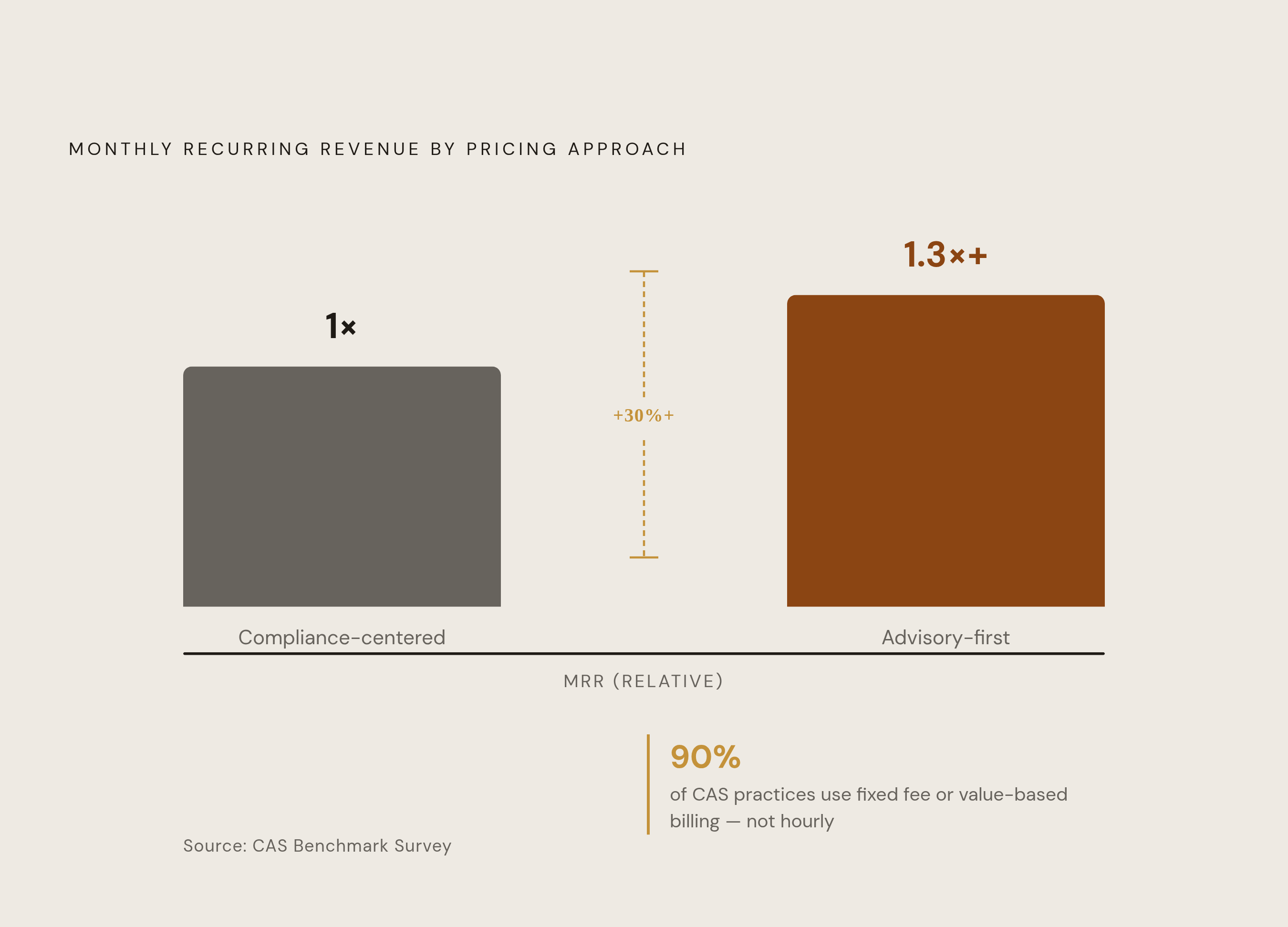
Hourly billing and advisory work don't fit together. Hourly billing anchors the client's attention to inputs, the time spent, rather than outcomes, the decisions actually improved. The CAS Benchmark Survey shows only 10% of CAS practices still bill advisory by the hour, with the rest using fixed fee or value-based approaches.
The revenue gap tied to that choice isn't subtle. The same survey data show firms leading with advisory-first pricing report over 30% higher monthly recurring revenue than firms still centered on compliance, a gap that changes what a firm can afford to invest in the following year. That's not a rounding error. It changes what a firm can afford to invest in the following year.
2026 market benchmarks give a place to anchor the conversation instead of guessing at a number. A Financial Oversight tier, $1,500 to $3,000 a month, fits clients in the $500K to $2M range who need discipline and visibility but aren't ready for full strategic engagement. A Virtual CFO or fractional advisory retainer, $1,500 to $5,000 a month, typically covers monthly close oversight, review calls, cash flow monitoring, and strategic input, with the top of that range reserved for clients carrying investor reporting obligations. Fractional Controller retainers run $2,000 to $6,000 a month. A senior compliance advisory retainer, essentially a compliance leadership function delivered on retainer, runs $3,500 to $10,000, priced on executive access rather than hours logged. At that top tier, the client is buying a function they'd otherwise have to hire in-house, full-time, with a salary and benefits attached.
The conversion conversation with a compliance client
Tax season is the wrong moment to pitch advisory. The client is fixated on the return, and the practitioner is stretched thin enough that any pitch lands as an upsell rather than a genuine offer. The right windows are the debrief immediately after filing and the mid-year check-in, when neither side is under deadline pressure.
The debrief conversation nearly writes itself: the filing's closed, and there were three things that, raised back in August, could have been structured differently. That framing positions the retainer as continuity, a formal version of guidance the client already got informally, rather than a new product being sold to them cold. Clients resist new things far more than they resist formalizing something already familiar.
One question drives the conversation, even when the client never says it out loud: what does this fee actually buy every month? The answer has to be concrete. A monthly review call. A quarterly projection update. An annual planning session with a name and a date attached. Clients respond to named deliverables. Telling them the firm is experienced does nothing for them.
How automation creates the capacity advisory retainers require
Advisory retainers take time, and time is what the profession has less of every year. The NASBA Accountancy Licensee Database put actively licensed CPAs at 653,408, down sharply from earlier in the decade, and industry projections point to a shortfall of 340,000 CPAs by 2030. Accounting bachelor's and master's graduates fell to 55,152 in the 2023 to 2024 academic year, a 6.6% drop from the year before. Firms cannot hire their way out of a pipeline that's shrinking while advisory demand climbs.
That leaves one lever: reclaiming hours already sunk into compliance work. If automation meaningfully cuts the time a return requires, those reclaimed hours are exactly the capacity an advisory retainer needs to run on. It's a direct transfer of hours from one column of the ledger to the other, nothing more mysterious than that.
AI tools applied to bookkeeping and tax prep are producing 20% to 40% reductions in time spent, with some industry reporting citing 50% to 70% reductions on standard returns. Even at the conservative end, that's real capacity freed up once compliance work closes out. The tasks getting automated first, document extraction, transaction categorization, standard return prep, invoice reconciliation, client intake, are the same ones that occupy junior staff and delay the advisory conversation. Automate that layer, and the hours it used to eat become the hours the retainer runs on.
Keeping advisory retainers compliant and defensible over time
A recurring fee brings recurring obligations. A retainer has to reflect the services actually delivered month to month, not the services described once in the engagement letter at signing, and the gap between those two things is exactly where regulatory exposure builds.
A 2025 thematic review of ongoing advice services by the FCA offers a useful governance model, even applied outside its own jurisdiction. Roughly 90% of advice clients in that market sit on ongoing service agreements, similar in spirit to a tax advisory retainer. The review found suitability checks, confirming the client still gets what they're paying for, were delivered in about 83% of cases, with around 2% showing a firm failing to attempt one. That reads like a solid record on its face, until you notice that a meaningful share of ongoing agreements showed gaps in the review process meant to justify the fee.
The lesson transfers directly. A retainer sold as ongoing guidance needs ongoing, documented delivery behind it: review calls that happen on the cadence promised, planning sessions that get held and recorded, not just billed. A recurring fee with no recurring, demonstrable service behind it is what draws regulatory attention, client disputes, or both. The firms building advisory revenue that lasts are the ones treating the scope document as an operating standard they answer to.
Sources
- What Is a Consulting Retainer? A Guide for 2026 | NetSuite
- The Future of Client Advisory Services: From Compliance to Cash Flow | Forwardly Blog
- How can firms keep their ongoing advice services compliant? | tcc.group
- The industry shift: From compliance to strategic advisory services | Wolters Kluwer
- getuku.com
- Compliance Consultant Fees: 2026 Benchmarks & Pricing Guide
- progeektech.com
- progeektech.com