Referral Systems That Generate Consistent New Tax Clients
Structured referral systems convert client satisfaction into predictable new business.

A busy filing season ends, and a handful of new clients show up on the engagement list with no clear origin story. Someone mentions a cousin, a neighbor, a business partner who had a good experience last year, and the firm nods, grateful, and moves on to the next return. That pattern repeats every spring at most tax practices, and it is the clearest evidence that a firm has referrals without having a referral system. Nothing triggered the ask, nobody tracked where the client came from, and nothing about the process could be repeated on command if the firm needed five more clients next month instead of two.
The distinction is structural. A firm that simply "gets referrals" is dependent on client goodwill and timing it cannot influence, while a firm with an actual system can diagnose why referrals have slowed, correct the problem, and forecast growth from the pipeline it built. Smart Firm Systems states the stakes: if referrals are the only source of new clients, growth is at the mercy of other people's conversations, and there is no lever to pull when more revenue is needed this month. Quality work is necessary for referrals to happen at all, but it is not sufficient to produce them reliably. Many practitioners assume that doing excellent work is itself a referral strategy, and that assumption is where the gap takes hold, because goodwill without a mechanism to activate it just sits there, unused.
Some practitioners will say their clients refer naturally and that formalizing the process feels unnecessary. Natural referrals tend to cluster around the same small group of highly engaged clients, and that flow tapers as the firm grows, with the relationship to any single client becoming one of hundreds as the client base expands. A system spreads the ask across the full client base rather than leaving it to the handful of people who would have referred anyone.
Why referral clients are worth building a system around
Referral clients are worth the effort of building a system because they arrive already trusting the firm, close faster, and are more likely to buy advisory services, which makes them a categorically different kind of lead than a marginally better one. The mechanism behind this is a transfer of credibility: a referred prospect inherits trust from the person who sent them, so the firm doesn't have to earn that trust from a standing start, and the time between first contact and signed engagement shortens as a result. Genius Referrals looks specifically at financial services, and it names trust as the defining trait of referral leads: personal recommendations carry a credibility no outbound channel can match.
That trust matters most where it can be converted into something beyond a single tax return. The Thomson Reuters 2024 State of Tax Professionals Report found that 66% of respondents said their clients are strongly in favor of receiving more business advice, and a referred client, who already trusts the firm before the first meeting, is more receptive to that advisory conversation from day one. AI-powered tools and free filing options put real pressure on basic tax preparation, so the growing value in the profession is now in planning, strategy, and advisory work. A client who arrived through a paid channel is often shopping on price, while a client who arrived through a trusted referral is already ready to engage at the level where the firm's expertise and advisory offerings matter, which shortens the path to an advisory conversation.
That difference changes the return on building a system. The case for investing in referral infrastructure includes generating better clients at a lower acquisition cost who are more inclined to buy the advisory services that represent the firm's future. A system built well enough multiplies its own return, because each referred client who engages in advisory work becomes a stronger candidate to refer the next one.
The three structural components every referral system needs
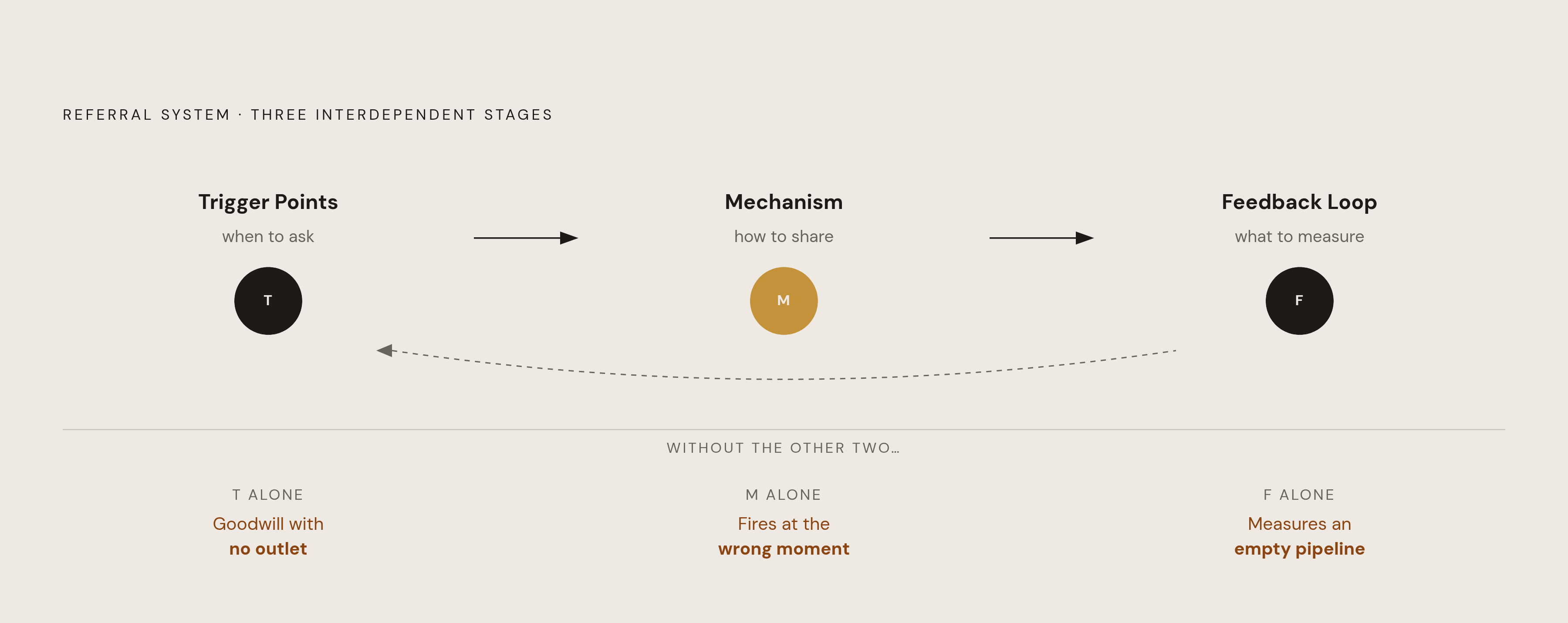
A referral system needs three components working in concert: trigger points that activate the ask, a mechanism that delivers and tracks it, and a feedback loop that shows the firm which relationships and services produce the best referrals. A firm missing any one of these does not have a system, regardless of how many referrals happen to arrive in a given year.
The three pieces depend on each other and fail separately in predictable ways. If trigger points are strong but there's no mechanism, the goodwill never becomes a lead, because the client feels inclined to refer but has no clear action to take. A mechanism without trigger points fires at the wrong moment, asking for a referral when the client's enthusiasm has already faded. Tracking without the other two produces data describing an empty pipeline, measuring nothing because there was nothing flowing through it to measure. Each of the next three sections takes up one of these components in turn, starting with the question of timing.
When to ask: engineering the moments that produce referrals
The post-filing window is the single highest-satisfaction moment in the entire client relationship, and a firm that lets it pass without asking for a referral is giving up its best opportunity of the year. Client satisfaction peaks right after a return is filed, when the relief of a resolved process, a favorable outcome, and the sense of a finished task are all working in the client's mind at once, and that peak decays quickly as life moves on and the tax season recedes from memory. An ask made within days of filing confirmation captures that goodwill while it is still at its strongest, and a templated follow-up sent promptly after that confirmation turns an emotional high point into a dependable trigger.
Delay is the clearest way this fails. The longer a firm waits after a positive moment with a client, the weaker the emotional anchor becomes for any referral ask that follows, so a firm that waits weeks, or simply hopes the client will think to mention the firm unprompted, is relying on exactly the kind of chance the rest of this argument is built to replace. Other moments in the client relationship deserve the same deliberate treatment. The end of onboarding, when a new client has just experienced a smooth intake process, primes that client to describe the experience to peers while it is fresh. A tax planning milestone, where a strategy produces a meaningful savings for the client, creates a natural moment of advocacy tied directly to a dollar figure the client can repeat to someone else. Quarterly advisory reviews, for firms that run them, create recurring touchpoints spread across the year.
That spread matters because most referral goodwill concentrates around filing deadlines, and a firm that relies only on the post-filing window recreates the same feast-or-famine pattern in its referral pipeline that it already experiences in its revenue. Building touchpoints throughout the year, tied to onboarding, planning wins, and advisory check-ins, counteracts that seasonality deliberately rather than leaving the firm dependent on a single springtime window. The framing of the ask itself should lean on gratitude. A message built around "we're glad we could help with this, and if you know anyone facing a similar situation, we'd be glad to help them too" lands differently than a direct pitch for new business, because it keeps the conversation anchored in the client's own experience.
Structuring the referral ask and the incentive to offer
The mechanism, meaning how the ask is framed, what incentive accompanies it, and how the handoff works once a referral arrives, shapes whether a willing client actually takes action. A client who feels grateful enough to refer someone still needs a concrete, simple path to do it, and firms that skip this step leave goodwill stranded with no outlet. Compliance constraints specific to CPA firms narrow the available options, and understanding those constraints before launching a program avoids a difficult correction later.
The dual-sided incentive principle holds that you reward both the referring client and the new client, so each party has a concrete reason to act. A program that rewards only the referrer tends to underperform, because the new client arrives with no activation signal of their own and nothing pulling them toward the firm beyond the referral itself. Utilitarian rewards, such as service credits or discounts on future engagements, tend to fit professional service relationships well, because the reward reinforces the ongoing value of working with the firm. Hedonistic rewards, such as gift cards or experiential prizes, can work in some contexts, but they often feel less connected to a professional relationship built on trust and competence. Uncompensated mutual referral arrangements, where each party sends business to the other with no money changing hands, carry no legal risk and often fit professional partner relationships more naturally than any paid incentive.
Genius Referrals documents two real structures that illustrate what a formal mechanism looks like. TM Taxes ran a campaign that offered a percentage of a referred client's first-purchase value back to the referrer, while RG Financial Group paid a flat $50 per-referral fee, and automated tracking handled the payouts. Both show what a formal mechanism looks like once it moves from a verbal request into an actual program with defined terms.
Compliance is not optional before any incentive program goes live. For non-attest clients, meaning tax-only or advisory engagements, a CPA may accept or pay a referral fee, but only with written disclosure to the client of the existence of the fee arrangement before or at the time of the referral. Some state boards also require disclosure of the specific amount and a signed client acknowledgment, but the AICPA Code itself does not mandate those two elements. None of this should discourage a firm from building an incentivized program. It simply means the disclosure has to be built into the mechanism from the start rather than added after a state board raises a question. The uncompensated mutual referral model remains a legitimate, legally clean alternative that many firms use successfully, particularly in relationships with other professionals.
Whatever structure a firm chooses, the mechanism has to account for what happens after the referral arrives. Who contacts the referred prospect, how quickly, and through what channel all shape whether the trust transfer that made the referral valuable in the first place survives the handoff. A referral that sits unanswered for several days loses the momentum the referrer's recommendation built, and the firm ends up treating a warm lead like a cold one.
Building professional referral partnerships beyond your client base
The client base is not the only source worth building a referral system around. If you run an established firm, your highest-leverage referral channel often comes from a small number of deep professional relationships, not a large list of casual contacts. Practitioners who build strong professional referral networks tend not to accumulate hundreds of loose connections from networking events. They cultivate a handful of partners who refer consistently, built on trust and a demonstrated track record of competent work.
Thomson Reuters names building a loyalty or referral program for current clients and employees as a reputation-building strategy, and that same logic extends naturally to professional partners, so it formalizes an exchange many firms already run informally without ever naming it. The "power team" model gives this shape: a small group of complementary professionals, such as a financial advisor, an estate attorney, a CPA, and a business broker, each serving overlapping client bases and referring within the group. Each member benefits from the arrangement without competing with any of the others, since each handles a distinct part of the client's financial life.
WTP Advisors, an international tax firm, shows what this model looks like in practice. The firm built a structured CPA collaboration program for domestic CPA firms whose clients run into international tax complexity those firms are not equipped to handle. The domestic CPA stays the primary advisor for the client's ongoing domestic work, the specialist steps in only for the international piece the CPA cannot handle, and the client relationship extends to the new firm. No client is lost in the arrangement, and both professionals come out ahead.
What makes a partnership like this durable over time comes down to three things: reciprocity, so referrals flow in both directions rather than one firm always giving and the other always receiving; clear scope, so each professional knows what situation should trigger a referral to the other; and a track record, since a referred client who has a good experience reinforces the partner's willingness to send the next one. Uncompensated mutual arrangements stay the cleanest structure for these relationships, since they need no written disclosure and don't vary by state board. If you have no existing relationships with attorneys or financial advisors, you don't need a wide network to start. One well-chosen relationship, built around a shared client situation and a successful first exchange, is enough to begin.
Tracking referrals so the system can improve itself
The third structural component, the feedback loop, lets a firm learn from the system it has built. Without tracking who referred whom, at what stage each referral sits, and which sources convert into signed engagements, a firm has no way to tell which client relationships or professional partnerships are actually producing results. Two referral sources can look equally active on the surface while one quietly converts at a far higher rate than the other, and a firm with no tracking in place has no way to see that difference, let alone act on it.
That blindness has a direct cost. Investment decisions, like which clients to prioritize for a referral ask, which professional partners to deepen the relationship with, or which incentive structure to keep funding, become arbitrary without data showing where the strongest returns actually come from. A firm that tracks referrals systematically can see, for instance, if a professional partnership sends higher-value clients than the client-referral program, or if referrals sourced right after filing convert at a higher rate than those sourced at onboarding. That information turns the trigger points and the mechanism from a one-time setup into something the firm can refine every season, directing effort toward the relationships and moments that have already proven they produce the best clients.