S Corporation vs LLC Entity Choice for Tax Practice Owners
When to split income between salary and distributions to save substantially on self-employment tax.

Tax practice owners spend their working lives running exactly this kind of analysis for other people. Yet a striking number of them operate their own firm as a default LLC, never having formally run the S corp election math on their own numbers. The reason usually is that practitioners are too busy to get to it, the same excuse they hear from clients every filing season. It's the same excuse practitioners hear from clients every filing season: too busy to get to it. This piece walks through the framework a practitioner would apply to a client's business and applies it to the practitioner's own practice, because the decision is an ongoing planning question rather than a one-time formation choice. It's an ongoing planning question that shifts as profit, salary strategy, and administrative bandwidth change.
What the LLC and S corp labels mean, and the common misreading that clouds the decision
An LLC and an S corp are not two versions of the same thing. An LLC is a state-law legal entity, created by filing articles of organization with a state. An S corporation is a federal tax election, made with the IRS. They sit on different axes entirely, which is why the question "LLC or S corp" is technically a little malformed. A practice can be an LLC under state law and elect S corp tax treatment at the federal level at the same time, by filing Form 2553. The legal entity doesn't change. Only the way it's taxed does.
Left alone, an LLC gets taxed one of two default ways depending on ownership. A single-member LLC is a disregarded entity: all net profit flows straight to the owner's Schedule C, and the full 15.3% self-employment tax hits every dollar of it. A multi-member LLC defaults to partnership taxation, and each member's share of profit carries that same SE tax exposure. Elect S corp treatment instead, and the owner has to be treated as an employee of the business, drawing a reasonable salary subject to payroll taxes, with everything left over paid out as a distribution that escapes employment tax. That gap, between what's taxed as wages and what's taxed as a distribution, is the entire mechanism behind the S corp election. Everything else in this piece is really just working out when that gap is big enough to matter.
How the salary-versus-distribution split determines the actual tax saving
Under the default LLC structure, the 15.3% self-employment tax rate breaks into two pieces: a 12.4% Social Security portion that applies only up to the wage base ($184,500 for 2026), and a 2.9% Medicare portion that applies to every dollar of net profit with no ceiling. Elect S corp status, and payroll tax applies only to the salary the owner actually processes through payroll. Distributions taken above that salary are simply not subject to it.
Run the numbers on a practice earning $100,000 in net profit. Pay yourself a reasonable salary of $60,000, and only that $60,000 gets hit with payroll tax. The remaining $40,000, paid out as a distribution, is not subject to that same employment tax. Scale it up: a practice netting $150,000, with an $80,000 salary, pushes $70,000 into distribution treatment, which works out to roughly $10,700 in annual tax savings before subtracting whatever the S corp election costs to maintain. The savings on paper and the savings in the bank account are two different numbers because of the "before compliance costs" caveat.
The profit thresholds that determine whether the S corp election is worth it
None of this is free. Running an S corp means running payroll, filing a separate corporate return, and generally paying an accountant more to prepare it all. Payroll processing alone typically runs $600 to $1,800 a year. Form 1120-S preparation adds another $800 to $2,500. State-level compliance costs $200 to $1,000, and basic corporate maintenance, minutes, registered agent fees, and the like, adds $300 to $800 more. Add it up and total annual overhead for the S corp election typically is between $2,000 and $5,000.
Compare that to the LLC baseline: a Schedule C or Form 1065 typically costs $500 to $1,500 to prepare. The incremental cost of electing S corp status is essentially the gap between these two ranges, and that gap is what the SE tax savings have to outrun before the election is worth doing.
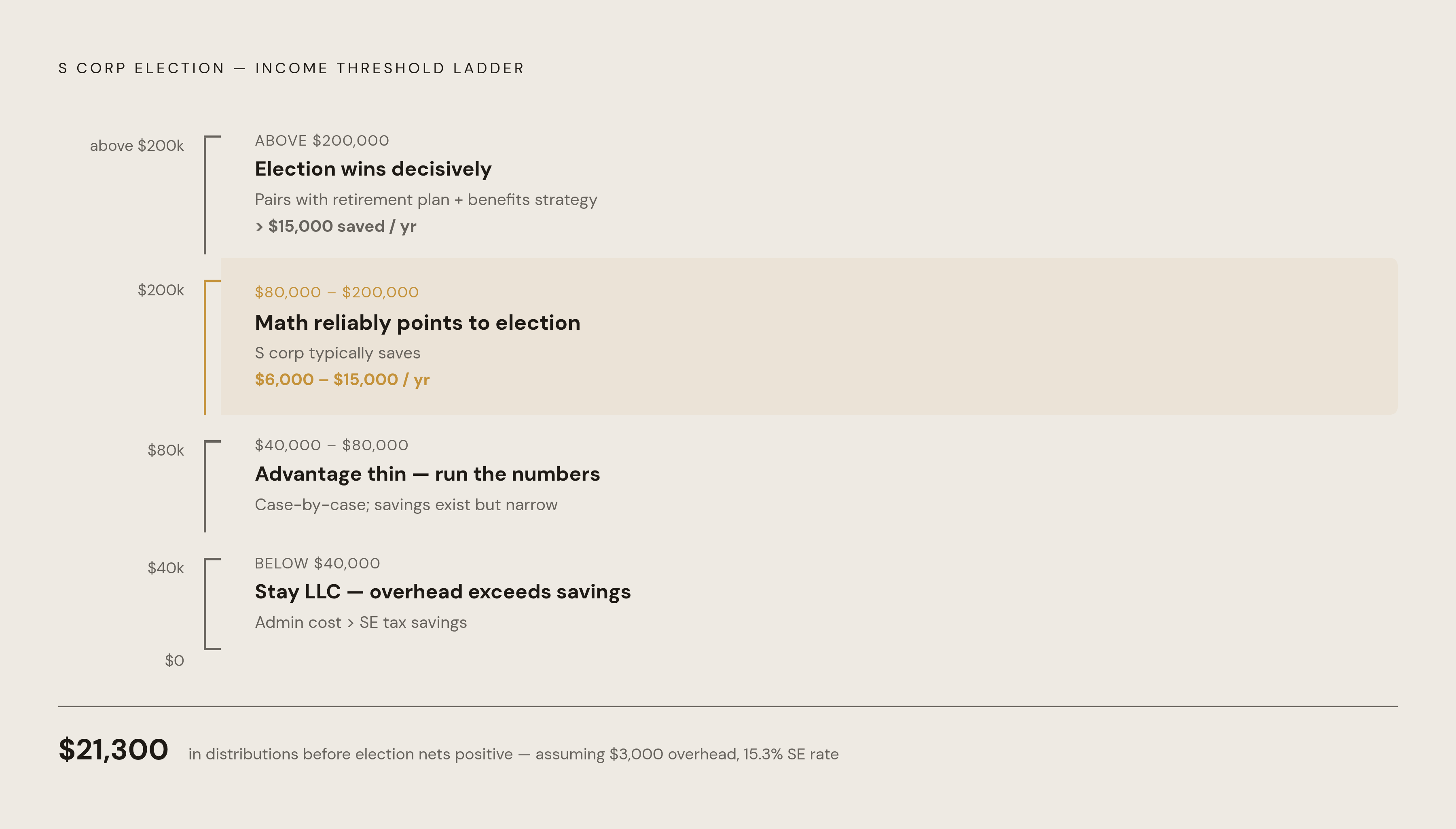
Do the breakeven math with a $3,000 overhead assumption and the 15.3% SE rate, and the amount pushed into distributions has to clear roughly $21,300 before the S corp actually nets out ahead. That threshold maps onto a rough income ladder. Below $40,000 in net profit, stick with the default LLC; the administrative cost eats more than the SE tax saving generates. Between $40,000 and $80,000, the advantage appears, but it's thin enough that it has to be run on the specific state and salary numbers rather than assumed. Between $80,000 and $200,000, the S corp election typically saves $6,000 to $15,000 a year, and the math usually points clearly in one direction. Above $200,000, the election wins decisively, savings can exceed that $15,000 floor, and the structure starts pairing well with retirement plan design and benefits strategy on top of the SE tax savings alone.
The reasonable salary requirement and its interaction with audit risk for a tax professional
A tax authority requires that S corp owner-employees pay themselves a "reasonable" salary before taking any distribution, and there's no published formula for what reasonable means. It's a facts-and-circumstances test built around role, industry norms, and what a comparable position would pay on the open market, not some internally generated percentage of revenue.
Recent case law has pointed toward a rough floor: shareholder-employees should be paid a meaningful share of what a comparable market-rate position would command, with some guidance pointing toward a floor in the range of 60% to 70% of that comparable rate. If the market rate for the role in question is $120,000, that puts the defensible floor somewhere around $72,000 to $84,000. Some practitioners default to a 60/40 split, 60% of income as salary, 40% as distribution, as a starting heuristic, and it's a reasonable place to begin. But it isn't an IRS rule, and treating it as one misses the point. The number has to survive comparison to what the role actually pays in the market.
The QBI deduction's interaction with the salary-distribution split, and the harder version of this problem tax practice owners face
The One Big Beautiful Bill Act, signed July 4, 2025, made the Section 199A qualified business income deduction permanent, closing off what had been a scheduled expiration at the end of 2025. The rate itself is rising too: 20% for 2025 returns, moving up to 23% for 2026 and beyond.
It gets genuinely tricky for a tax practice owner specifically. The QBI calculation interacts directly with how income is split between salary and distributions, and the two don't move in the same direction. That sets up a real tension in the same salary-setting decision discussed above. Pushing the salary higher to build a more defensible reasonable-compensation position shrinks the QBI deduction base, because there's less left over in distributions to qualify. Push the salary lower to maximize the QBI deduction, and audit exposure on reasonable compensation grows. There's no setting that maximizes both at once. A tax practice owner isn't just solving the standard self-employment tax optimization problem that any small business owner faces. There's a second variable layered on top of it, and the two pull in opposite directions.
The administrative burden the S corp election adds to a practice, in time and money
Electing S corp status turns the owner into an employer, formally and permanently, not as a one-time setup task. That means payroll has to be established and run continuously: quarterly payroll tax filings, W-2 issuance at year-end, and employer-side tax deposits on an ongoing schedule.
On top of the payroll obligation, corporations carry governance requirements that LLCs simply don't have. A board of directors, annual meetings of directors and shareholders, corporate minutes documenting those meetings, and annual state filings all become part of the routine. A separate Form 1120-S has to be filed every year, a return entirely distinct from the personal 1040 and from whatever Schedule C or Form 1065 the practice filed before electing S corp treatment. Altogether, total annual compliance cost for the S corp structure typically runs in the range of $2,000 to $6,000, landing toward the lower end for a simple single-owner practice and climbing for practices with employees or operations spread across multiple states.
The One Big Beautiful Bill Act's 2026 changes to the entity decision calculus
The OBBBA isn't a future proposal. Signed into law on July 4, 2025, its provisions are current law governing 2026 planning right now, and several of them bear directly on the choice between entity structures.
The QBI deduction becoming permanent, at the higher 23% rate for 2026, raises the value of the distribution portion of S corp income for practices that fall below the specified service trade or business phase-out threshold. That makes the distribution side of the salary-distribution split worth more than it was under the prior 20% rate, which nudges the breakeven math in the direction of pushing more income into distributions eligible for the deduction.
The law also permanently restores 100% bonus depreciation. For an S corp owner buying qualifying equipment or technology in 2026, that means writing off the full purchase cost in the year it's placed in service, rather than spreading it out. That changes the after-tax economics of any capital purchase a practice is weighing, tax software licenses, hardware upgrades, office equipment, and it's a consideration that sits on top of, not separate from, the entity choice itself. And the SALT cap rose to $40,000, a change that alters the state and local tax math practitioners need to fold into their own planning the same way they'd fold it into a client's.
None of these provisions change the basic decision framework. The thresholds, the reasonable salary requirement, the QBI interaction, the compliance cost, all of it still applies exactly as before. What the OBBBA changes is the value sitting on one side of the ledger, which is precisely the kind of shift a tax practice owner would flag immediately for a client and now has direct reason to flag for the practice itself.