Productized Service Packages for Solo Tax Practitioners
Fixed pricing and clear scope eliminate the margin leaks that plague solo tax practices.

Solo tax practitioners lose money the same way every year: they quote each engagement from scratch, negotiate scope on the fly, and hope the invoice covers the hours that scope creep quietly added. Productized service packages fix this by defining what a client gets, what it costs, and how it gets delivered, before the engagement letter is even signed. The rest of this piece walks through how to build that structure, tier by tier, price point by price point, and how to bring existing clients along without losing them.
What productized services are, and why accounting is naturally suited to them
A productized service has a fixed price, a fixed scope, and a workflow that doesn't change from client to client. The client buys a defined outcome, not an open meter. That's a different animal from repackaged hourly billing with a nicer name on it: clear packages with visible deliverables and costs, repeatable procedures that work across many client types, fixed pricing with no custom-quote emails, scope boundaries that state what's excluded, and a purchase process that's close to self-serve produce the difference.
Accounting work already runs on cycles: monthly bookkeeping, quarterly estimates, annual filing. The work repeats by its nature. The repetition usually isn't missing. The packaging around it is. A custom-delivery practice runs the same loop for every client: proposal, negotiation, contract, invoice. A productized practice sends the client to a pricing page and lets the package do the selling.
The bigger shift is in cash flow. When packages carry recurring fees instead of one-off invoices, the practice starts behaving more like a subscription business, where a baseline of revenue is known before the season even begins. Productizing doesn't strip out professional judgment, either. It clears the process decisions out of the way (how the file moves, who reviews it, what gets communicated when) so the practitioner's judgment goes toward the tax questions that actually need it.
Market signals pushing solo practitioners toward fixed-fee packages right now
Pricing has already moved. NATP data shows the average base charge for a Form 1040 with Schedules climbed to $236 in 2025, up from $162 in an earlier year in the same study series, a substantial jump, and that's before adding complexity premiums or additional state returns. Clients are already paying more. The practitioner either captures that value inside a defined package or bleeds it out through scope creep and fee write-downs at year-end.
Industry reporting has pointed to firms finding ways to grow revenue and profit in 2025 even while short on staff, with a notable share expanding into tax strategy and business consulting work. Ignition's 2025 report backs this up from a different angle: 80% of firms planned to raise prices heading into 2026, and two-thirds of firms that had already raised prices either lost no clients or lost some but kept profitability steady. That undercuts the standard fear that transparent, fixed pricing scares clients off.
Generative AI is compressing the time routine compliance work takes, and firms are increasingly incorporating it into their workflows. That makes packaging the compliance layer more efficient and the advisory layer, the part AI can't replace, more valuable by comparison. Meanwhile the profession itself is fragmenting: solo and micro-firm practitioners increasingly choose to stay small rather than scale into a bigger firm. Productization is the operating model that lets them compete without adding headcount.
Designing tiers that reflect how clients differ, not how labels sound
The most common mistake is starting with names. Bronze, Silver, Gold sound tidy on a pricing page, but a label doesn't solve scope, and tier names should be the last decision made, not the first. Start instead with how clients actually differ: some want filing done accurately and nothing else. Some want to avoid tax-time surprises and expect a check-in or two through the year. Some have a financial picture that changes constantly and want a practitioner they can call before making a decision, not after.
That maps to three tiers most solo practices land on. A Compliance tier for the client who wants accuracy and delivery and nothing more. A Proactive tier for the client who wants scheduled communication and a heads-up before estimated payments come due. An Advisory tier for the client whose situation shifts during the year, who wants a partner rather than a preparer.
A tier is real only if the deliverable actually changes between levels. If a Gold client gets the same return, same timeline, same communication as a Bronze client, minus a fancier PDF cover, the tier is a discount dressed up as a choice. It's a discount dressed up as a choice. Each level has to change both what the client experiences and what the internal team actually does to produce it.
The decision shifts from "yes or no" to "which one," and buyers commonly gravitate toward the middle option. That makes the middle tier the highest-leverage design decision in the whole structure, worth more design time than the other two combined.
Complexity needs its own pricing logic, built in from the start rather than negotiated case by case. Brokerage activity, K-1s, and multistate filings should trigger either a tier bump or a defined add-on fee. Communication load, family offices, multiple sign-off layers, an assistant cc'd on every email, is a separate variable and deserves its own line. Late-arriving corrections should be a named add-on, not labor the practitioner absorbs quietly. Segmentation should follow operational need: a high-net-worth client who just wants a clean, simple return belongs in Compliance, regardless of what their income documentation says.
Deliverables that clients can see and staff can repeat
The strongest deliverables share two properties: the client can see them, and the team can repeat them without reinventing the process each time. If a deliverable can't be named on a page, it can't be priced, and it can't be trained into a junior preparer's workflow.
A package document needs to settle five things before a client ever signs: named deliverables at every tier, the review standard every file passes through before delivery, scope exclusions stated in plain language, how often and through what channel the practice communicates, and what turnaround the client should expect.
At the Compliance tier, that typically looks like an intake organizer and document checklist, preparation of the federal and state return, e-file submission with confirmation, clear payment instructions and deadline reminders, and an audit-ready file kept on hand for the engagement period. The Proactive tier adds quarterly estimated tax calculations, one or two scheduled check-in calls across the year, a year-end planning summary, and status updates through filing season. The Advisory tier adds ongoing decision support around entity changes, retirement contributions, or equity events, proactive outreach when tax law or the client's situation shifts, a written plan naming specific strategies with a projected dollar impact, and priority turnaround.
The governing rule: if something happens on most returns already, it belongs in the package, named, priced, and assigned to a specific person to own. Invisible effort can't be priced, and it's invisible effort that erodes margin fastest. Planning advice that quietly gets folded into a compliance fee, then written down when the invoice looks too high, trains the client to expect that advice for free going forward. Keep the two separated on paper, even when the same person delivers both. Anything outside the tiers, additional state returns, amended returns, audit representation, identity protection work, should sit on a published add-on rate card rather than get negotiated client by client.
Pricing each tier: benchmarks, models, and where value-based fees fit
Published benchmarks give a workable anchor. A 2025 guide from madrasaccountancy.com put the average CPA-prepared Form 1040 with Schedule A and a state return at a flat fee of $323. Real published pricing pages show the range in practice: SE Tax Firm lists flat rates of $349 for individuals, $749 for homeowners and families, and $999 for the self-employed, an example of a solo practice publishing no-surprise pricing in plain sight. Business returns generally start around $800 and climb from there based on entity type and complexity.
Advisory work carries a wider range. Industry guidance puts individual tax planning at $3,000 to $8,000 a year for solo and small firms, business-owner advisory at $5,000 to $15,000, and published advisory pricing benchmarks put multi-entity clients, real-estate portfolios, or heavy equity compensation situations at $15,000 to $30,000 annually. Bundled monthly packages, bookkeeping plus tax plus planning together, scale up with complexity, which shows the annual-fee model is one valid structure among several, not the only one.
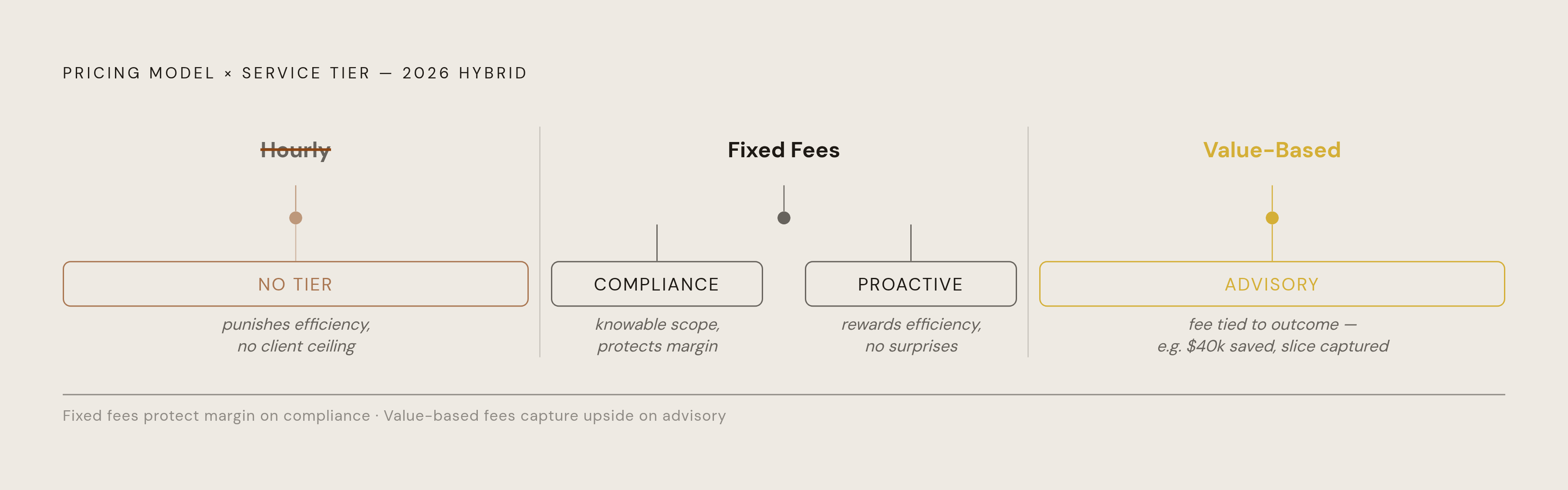
Three pricing models exist, and each fits a different tier. Hourly billing, at rates that vary by region and complexity, is increasingly the wrong tool for compliance work: it punishes the practitioner for getting faster and hands the client an invoice with no ceiling. Fixed fees suit the Compliance and Proactive tiers, where scope is knowable in advance, protecting the client from surprise and rewarding the practitioner for efficient delivery. Value-based fees belong in the Advisory tier, where the fee ties to outcome rather than hours: if an S Corp election paired with retirement plan optimization saves a business owner $40,000, a fee representing a slice of that saving is an easier conversation than an hourly bill for the same work. Ignition's 2025 report found that firms raising prices through fixed and value-based structures largely retained their clients, suggesting that confident, transparent pricing reduces friction at renewal.
A common approach in 2026 is a hybrid: fixed fees for the routine compliance work, value-based fees for advisory, protecting margin on the commodity side while capturing upside on the higher-value work. Publishing package pricing gives clients clarity upfront and aligns with broader professional standards around fee transparency.
Building the intake-to-delivery workflow that makes fixed fees profitable
Fixed fees without a defined process just move the risk from the client's invoice to the practitioner's calendar. Every inefficiency, late documents, unclear intake, a missing organizer, gets absorbed as unpaid time instead of billed hours. The fix is mapping the file's path from intake to sign-off as a named sequence rather than a habit that lives in someone's head.
That sequence runs through six stages: intake, using a standardized organizer and a named upload method; review, with defined checkpoints for what gets verified before preparation starts; preparation, with documented steps tied to the client's tier and a clear owner; quality review, a standard every file meets regardless of which preparer touched it; delivery, meaning e-file confirmation, payment instructions, and a filing summary in the client's hands; and post-filing, where the audit-ready file gets retained and a follow-up trigger fires for Proactive and Advisory clients.
Late documents need a policy decided in advance. A late-arriving correction should trigger one of three defined responses, a timeline extension, an add-on fee, or an explicit scope exclusion, decided in advance rather than negotiated in the moment when the client is already anxious about a deadline.
Automation has a real role here, particularly around the communication load that eats hidden hours: status updates, document requests, reminder emails. Purpose-built tax workflow software tends to outperform generic project management tools for this because the steps are already mapped to how tax work actually moves, rather than requiring a practitioner to build a tax-specific intake flow inside a tool built for something else.
The final file itself deserves treatment as a product, not backend cleanup. An organized, audit-ready record isn't just tidy housekeeping, it's a visible deliverable that justifies the fee and reduces risk downstream. The IRS Data Book reports that the IRS closed hundreds of thousands of audits in recent fiscal years and recommended tens of billions in additional tax. Documentation quality still matters well after the return has already gone out the door. Standard procedures do double duty here: they make delivery consistent for the client, and they make the practice itself trainable, measurable, and eventually something that can run without the founder touching every file.
Presenting packages to clients: positioning, language, and the rollout conversation
Packages should be presented as what the client gets, not what the practice charges. A pricing tier isn't a price list item, it's a defined outcome, and the language around it should name deliverables, a turnaround commitment, and a communication cadence, not a dollar figure sitting alone on a page.
Rolling this out to existing clients calls for a direct conversation rather than a quiet fee hike buried in an engagement letter. Acknowledge that the pricing structure is changing, and name the benefit: no more surprise invoices, a defined turnaround window, and clarity upfront about what's included before the engagement even starts. Clients who've been billed hourly for years, never quite sure what the final number would look like, tend to respond well to that kind of certainty once it's explained rather than assumed. The pricing surge already underway across the profession means most clients have already absorbed higher fees somewhere. A well-built package gives them something concrete in return for that cost, including a defined scope, a name attached to their return, and a fee they know in advance instead of one they find out about when the invoice lands.