Separating Compliance and Advisory Fees in Client Billing
Bundling compliance and advisory fees hides the real value of strategic work and caps firm revenue.

Compliance work and advisory work are not the same product wearing different labels, and billing them identically is the single most common pricing mistake in accounting firms today. One is a defined deliverable with a knowable price; the other is a judgment call whose value depends entirely on what happens after the invoice is sent. Firms that keep charging for both the same way are quietly capping their own revenue and confusing the very clients they're trying to convert into long-term advisory relationships. Separating Compliance and Advisory Fees in Client Billing.
Why compliance and advisory work price differently by nature
Compliance work has a shape you can see before you start. A tax return, a bookkeeping cycle, and a payroll filing each have a defined scope, a repeatable process, and an output that doesn't change much from client to client or year to year. Advisory work has no such shape. Cash flow forecasting, scenario planning, CFO-level strategy work: these are open-ended by design, and the value they produce depends on decisions made after the engagement, not on hours logged during it.
That's the predictability gap, and it makes compliance fees easy to quote in advance while advisory fees cannot be fixed the same way, since advisory responds to conditions that haven't happened yet. Compliance output is knowable at the moment of signing; advisory output is not, because the entire point of advisory work is to respond to conditions that haven't happened yet. A firm can price a Form 1120-S with confidence because the deliverable is fixed CPA Firm Pricing Strategy (2026): Fixed-Fee vs Value-Based Guide ProGeekTech. It cannot price a scenario-modeling engagement the same way, because the value of that engagement depends on which scenario the client actually walks into.
A value gap causes the predictability gap, and it's structural, not marginal. Advisory work generates more client value per hour than compliance work does, and not by a small margin. A tax return saves a client from noncompliance. Those are different orders of consequence, and pricing them identically flattens that difference into invisibility.
That flattening is itself a signal, and clients read it regardless of whether firms intend them to. Charge the same way for both services and the client concludes, reasonably, that they're the same kind of service. That makes advisory harder to sell, harder to justify, and harder to retain once sold, because the billing structure has already told the client not to expect anything different. Most firms that struggle to grow advisory revenue don't have a delivery problem. They have a pricing architecture problem, and it tends to hide in plain sight on the invoice.
What the market currently charges for each type of work
The numbers make the gap concrete. S-corporation returns for a straightforward small business typically run $1,500 to $3,000 CPA Firm Pricing Strategy (2026): Fixed-Fee vs Value-Based Guide ProGeekTech. Across all services, the CPA Trendlines 2026 Cornerstone Report puts the median "typical client" fee at $1,263, though that figure blends compliance and advisory together, meaning advisory-only engagements run to multiples of that number once isolated.
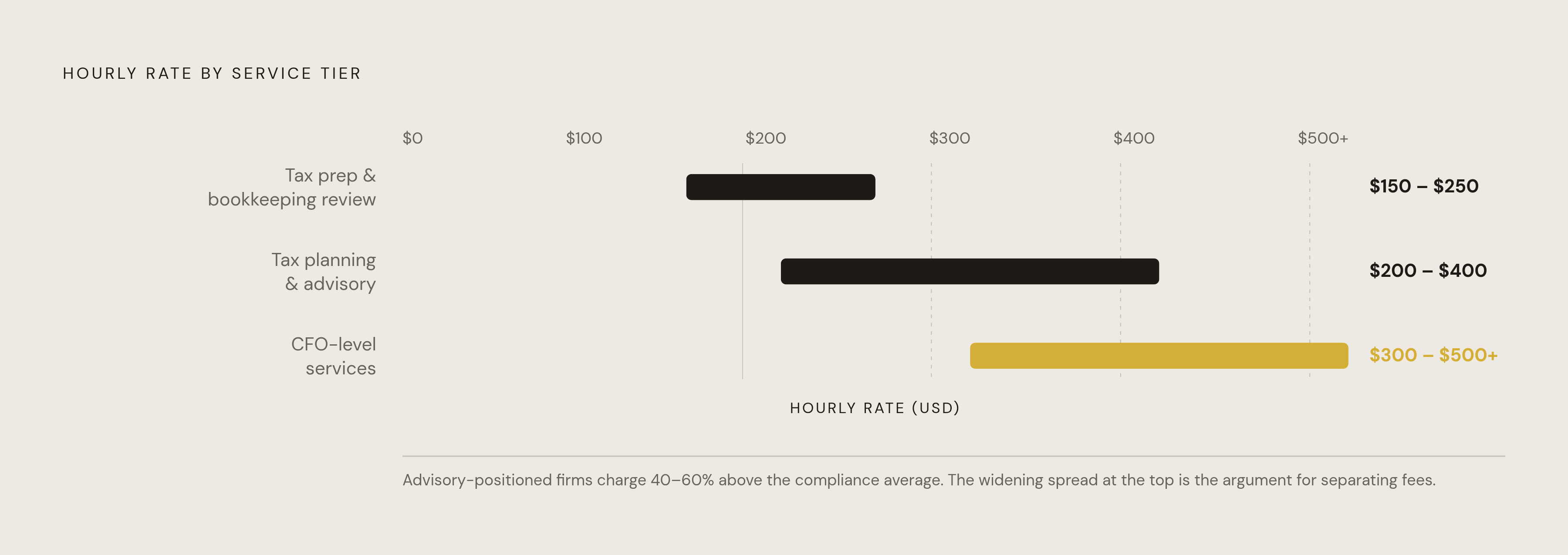
Hourly rates tell a similar story. Tax preparation and bookkeeping review run $150 to $250 an hour How to Price Accounting Services: 2026 Rates, Fee Structures & Benchm… Compliance Consulting Fees in 2026: A Strategic Guide to Budgeting fo…. Tax planning and advisory work commands $200 to $400 an hour, and CFO-level services push to $300, $500, or more How to Price Accounting Services: 2026 Rates, Fee Structures & Benchm…. Firms with strong advisory positioning charge 40 to 60% above the compliance average and don't face client resistance doing it. Median CAS net client fees per professional reached $156,250 in 2023, up 29% from the year before, per the AICPA/CPA.com CAS Benchmark Survey ProGeekTech.
None of these figures are prescriptions. They're reference points showing the spread between what compliance commands and what advisory can command when priced on its own terms. That spread is the argument for separation, stated in dollars rather than theory. The national average base fee for Form 1040 with Schedules 1–3 rose 45.7% in two years, per CPA Trendlines, signaling commodity pricing pressure even as fees rise. The NSA fee survey found a national average of $323 for a Form 1040 with Schedule A, described in the research as "the floor, not the target" How to Price Accounting Services: 2026 Rates, Fee Structures & Benchm…. Advisory fee benchmarks are established for CAS practices.
How bundling compliance and advisory fees into one invoice undermines both
Putting advisory as a line item under a compliance invoice causes the client to anchor its value to the compliance work sitting above it, not to the outcome the advisory work actually delivers. Advisory stops looking like a strategic engagement and starts looking like an add-on to a tax return. That's an anchoring problem, and it's hard to undo once a client's mental model locks in.
Hourly billing makes it worse. It rewards time spent, not results achieved. A practitioner who builds efficient workflows and delivers a better outcome faster actually earns less for it. That's the wrong incentive running through the entire relationship. Clients watching the clock hesitate to call with questions, scope disputes crop up over what counted as billable, and invoices start feeling unpredictable in a way that erodes trust rather than building it. Hourly billing also caps income at whatever hours a firm can physically staff, a ceiling that only tightens as the profession deals with a shrinking talent pool.
The AICPA/CPA.com CAS Benchmark Survey found only 10% of CAS practices still bill advisory hourly. Firms still bundling compliance and advisory into one hourly invoice are operating against inertia. They're operating against the grain of where the profession has already gone. That's not a rounding error. Without a clear outcome proposition, advisory is perceived as an additional cost rather than a growth tool, a common challenge documented in Fathom's 2025 state of advisory services research. Firms that separate and price advisory correctly report revenue per client increases of 150–300% on transition from commodity to value-based models.
Fixed or flat-fee pricing for compliance work: coverage and how to set it
Fixed-fee pricing works for compliance precisely because the conditions for fairness are already in place, since scope is knowable in advance, the output is defined, and the delivery process repeats from one engagement to the next. Annual tax preparation across the common entity types, including 1040, 1120-S, and 1065, fits this model cleanly.
Scope definition is the actual discipline here, more than the number itself. Most fixed-fee disputes trace back to a gap between what the client thought was included and what the engagement letter actually covered. Writing scope down before setting the fee isn't paperwork; it's the mechanism that makes the fixed price defensible. Set the fee based on the complexity of the return or entity type, the volume of transactions running through the books, the number of jurisdictions involved, and a historical time-to-complete baseline pulled from prior engagements of similar shape.
Fixed-fee pricing is now the dominant choice across the profession. It's the dominant model in accounting and tax services broadly, used by 54% of firms according to Ignition's U.S. Accounting and Tax Pricing Benchmark Report, up from 50% the year before. Part of what makes that shift sustainable is delivery-side efficiency: as intake, document review, and routine compliance checks get faster through better internal processes, margin improves without the firm needing to raise the client-facing rate at all. Predictable costs on the delivery side are what make predictable prices on the billing side defensible over time, rather than a bet the firm loses quietly on the busiest returns.
What doesn't belong in a fixed-fee compliance package is anything requiring judgment calls, strategic recommendations, or scenario modeling. That work carries a different value proposition, and folding it into the compliance fee is exactly the bundling mistake the rest of this argument is built against.
Value- and outcome-based pricing for advisory work: the three models in use
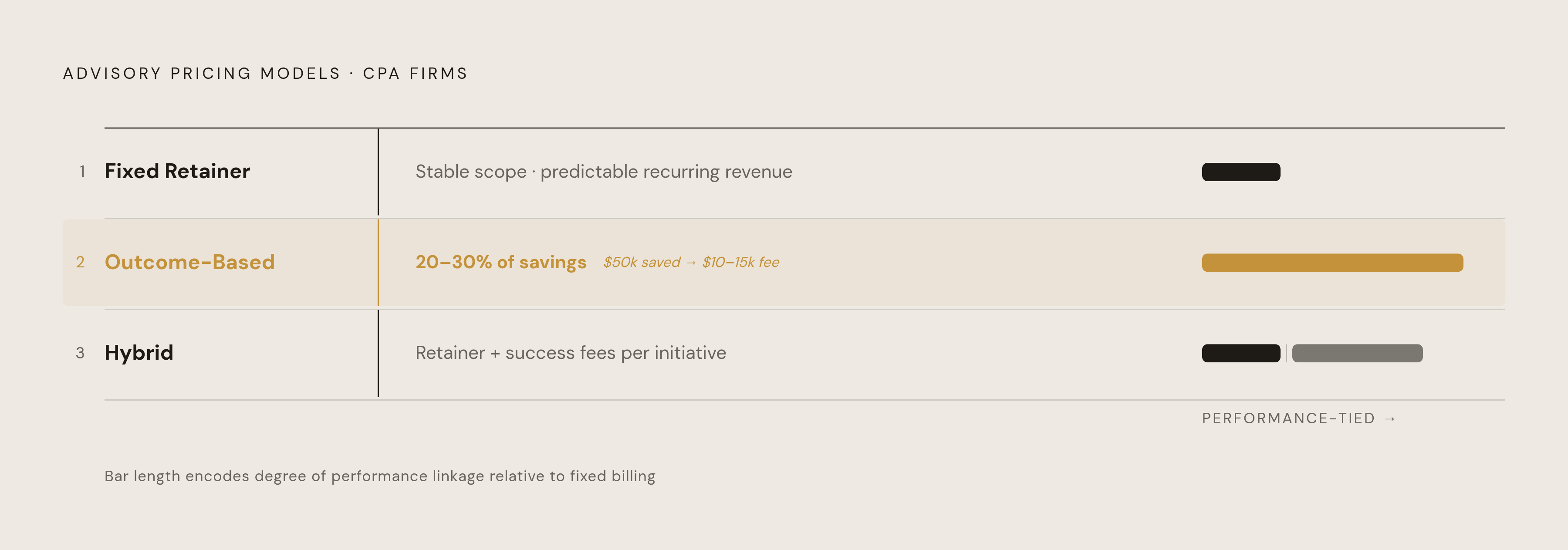
Advisory pricing starts from a different question entirely. Compliance asks how long something will take; advisory asks what the outcome is worth to the client sitting across the table. CPA firms running client accounting services tend to use one of three models to answer that question, per Compass AI's CPA advisory pricing guide.
The first is the fixed monthly retainer, which packages a defined set of advisory services into one predictable monthly charge. This model suits ongoing relationships with stable scope: it gives the client cost certainty and gives the firm predictable recurring revenue, which is its own kind of value.
The second model ties the fee directly to the financial result delivered. A common structure charges 20 to 30% of documented tax savings generated, so a strategy that produces $50,000 in savings justifies a fee at that share, regardless of how many hours it took to design. This model demands the most upfront discipline, because success has to be defined and measured before the engagement starts, not argued about after.
The third is a hybrid: a fixed retainer covering ongoing advisory access, layered with project or success fees for defined strategic initiatives. This tends to work well for clients moving up from a compliance-only relationship who aren't ready to commit to full value-based pricing yet, giving them a bridge rather than a leap.
Whichever model applies, advisory needs its own name on the invoice, something like "Growth Partner" or "Virtual CFO," not a fee line sitting beneath a compliance quote. The Essentials tier, covering monthly reporting, cash flow monitoring, and one advisory call, is priced at $1,500–$3,000/month CPA Firm Pricing Strategy (2026): Fixed-Fee vs Value-Based Guide. The Full CAS tier, covering reporting, forecasting, variance analysis, and strategic calls, is priced at $3,000–$6,000/month. The CFO-level tier, covering board prep, fundraising support, and scenario modeling, is priced at $6,000–$12,000+/month. Firms that lead with advisory-first pricing earn more than 30% higher monthly recurring revenue than compliance-focused peers, per the AICPA/CPA.com CAS Benchmark Survey. CAS practices reporting 17% median growth in 2023, per the AICPA/CPA.com survey, are predominantly those using recurring, outcome-oriented models rather than hourly billing.
How to structure the engagement documents that formalize the separation
The separation has to exist on paper as well as in the firm's internal thinking. Compliance and advisory need separate engagement letters.
A compliance engagement letter should name the deliverables specifically (which return types, which filing deadlines), state the fixed fee explicitly along with payment terms, and spell out what's excluded: any planning, advisory calls, or scenario work that falls outside the fixed scope. It should also include a refund or proration policy in case the engagement ends before completion.
An advisory engagement letter needs a different set of elements: a plain-language description of the service tier, a formula for how the fee is calculated that the client can verify independently, whether fees are charged in advance or arrears, how outcomes or savings will be measured if the pricing is value-based, and clear termination terms covering the treatment of any prepaid fees.
For RIA-registered firms specifically, the Form ADV Part 2 brochure has to describe each service category and its fee separately, and the advisory contract has to set out exact negotiated fee rates per service, per NASAA's disclosure guidance, so that a client who can check their own fee calculation is far less likely to dispute an invoice and far more likely to see the firm as straightforward. None of this is bureaucratic overhead for its own sake. A client who can check their own fee calculation is a client far less likely to dispute an invoice, and far more likely to see the firm as straightforward rather than opaque. It's worth keeping a record, too, of the value actually delivered (meeting notes, outcome summaries, decision logs) so the fee holds up to scrutiny at renewal time and, if it ever comes to it, under regulatory review. NASAA guidance specifies that firms should review business practices at least annually and file an annual amendment to Form ADV Part 1 and 2, that changes outside that annual review may trigger an other-than-annual amendment, and that an amendment to one disclosure document likely necessitates amending the others.
The regulatory case for keeping compliance and advisory fees separated on paper
Regulators don't treat fee separation as a best practice. They treat it as a disclosure obligation. Item 5 of Form ADV Part 1A requires all fees and advisory services to be disclosed, and examiners check that the fees described in Form ADV Part 1, the Part 2 brochure, and the advisory contract itself all say the same thing and match what the firm is actually billing. Several states go further, requiring RIAs to send a separate invoice directly to the client whenever a fee is charged; billing through a custodian doesn't always clear that bar.
The regulatory temperature on this has been rising. The SEC's examination priorities call out fee structures for scrutiny broadly, including fund adviser arrangements, sub-advisory fees, and whether expense-cap waivers are actually honored in practice, per Grant Thornton's analysis of those priorities. A Risk Alert found that firms' policies and procedures frequently failed to capture the full range of fee arrangements actually in use, and that boilerplate fiduciary language no longer satisfies Staff expectations, according to Kroll's read of the alert. And enforcement has teeth behind it: in January 2025, the SEC fined 12 firms more than $63 million for recordkeeping failures, with fee documentation sitting squarely inside the recordkeeping universe under examination.
States can and do expand on federal requirements rather than simply mirroring them, so satisfying the SEC's floor doesn't guarantee satisfying the state where a given adviser is registered. A bundled invoice that blurs which fee covers which service is a potential examination finding at that point. It's a potential examination finding. For non-RIA CPA firms, while SEC/RIA rules apply to registered investment advisers specifically, the underlying principle that fees charged must be clearly tied to services rendered reflects broader professional standards and state CPA board expectations.
Communicating the separation to existing clients without triggering resistance
Existing clients tend to see their accountant as a compliance provider, full stop, and repositioning that relationship into something more strategic means changing how the client thinks about the firm, not just changing what the invoice says. That's a harder conversation than adjusting a price, and it has to be handled as one.
Lead with the outcome. The conversation should open with what the client actually gets from advisory work, not with the fact that they'll now be billed separately for it. Timing helps too, since a compliance renewal is a natural moment to introduce a new engagement structure, a year-end planning session gives advisory a visible and time-relevant hook, and the strongest moment of all tends to follow right after a win, a tax saving or a strategic call that already paid off, when the value is still fresh and easy to point to.
Framing matters as much as timing. Present advisory as a named service package rather than an add-on fee, and clients start comparing packages instead of scrutinizing individual line items, which changes the whole tenor of the conversation. Resistance, when it occurs, usually traces back to invisible ROI rather than to the fee itself, so building outcome tracking, savings records, and decision logs into the advisory engagement from day one heads off that objection before it becomes one. Firms making the transition to value-based advisory pricing report client retention improvements of 40 to 60%, and the clients who stay through that transition tend to be the higher-value, more engaged ones, which says something about who the old bundled pricing was actually serving.
Clients who genuinely want compliance only remain a legitimate segment, and the separation makes it easier to serve them cleanly, without their fixed fee quietly subsidizing advisory work they never asked for and never receive.
Sources
- Compliance Matters: Clear and Reasonable Disclosure of Fees - NASAA
- How to Price Client Advisory Services at Your CPA Firm 2026
- How Do I Price Advisory Services as an Accountant in 2026?
- How to Price Accounting Services: 2026 Rates, Fee Structures & Benchmarks - Accounting Practice Management Software - Uku
- 2025 U.S. Accounting and Tax Pricing Benchmark | Ignition
- Cornerstone Report: Tax, Accounting and CPA Billing Rates and Pricing Trends for 2026 - CPA Trendlines
- CPA Firm Pricing Strategy (2026): Fixed-Fee vs Value-Based Guide