Value-Based Pricing for Tax Engagements
Hourly billing masks the real value tax advisors create and costs firms millions in captured profit.

Hourly billing pays for the wrong thing. It rewards the time a return takes to prepare rather than the outcome that return produces for the client on the other side of the engagement letter. A practitioner who spots a six-figure tax savings in a twenty-minute call and bills that call at a standard hourly rate has just given away most of the value created in that room. The gap between what tax work is worth and what it gets billed for is the entire subject of this piece.
The mechanics of hourly billing create three distortions, and each one works against the client and the firm at the same time. Slower work earns more than faster work, which punishes the practitioner who gets efficient at solving a problem. Clients open a final invoice with no idea what number will be on it, which breeds a low-grade anxiety that has nothing to do with the quality of advice they received. And the fee structure only rewards the firm after something has already gone wrong, an amended return, a notice response, an unwound bad entity election, rather than at the moment the firm prevented the problem from happening.
The profession has already started walking away from this model. The Accounting and Tax Pricing Benchmark Report, based on a national sample of 219 firms, found that only 3% still charge hourly for tax prep. That's a model in its final stages of abandonment at the practice level. What replaces hourly billing is the harder question: once hourly is off the table, how does a firm build a fee structure around the value of the expertise being sold rather than the clock time it took to apply it?
What value-based pricing means in a tax engagement
Value-based pricing sets the fee according to what an outcome is worth to the client, not according to hours logged, and not according to a flat rate assigned to a defined scope of work. Plenty of firms believe they've already made this shift simply by moving to fixed fees. They haven't made this shift, because moving to fixed fees alone does not change how a fee is determined.
A flat fee for a 1040 is still a delivery model. It answers what the return costs the firm to produce, just with a fixed number instead of a variable one. Value-based pricing asks something else entirely: what is this outcome worth to this specific client, with this entity structure, this income situation, and this set of goals for the next twelve months? Not the average client. Not the firm's internal cost structure.
Answering that means pricing two kinds of value, and most firms only ever price for one. Financial value is the easy half: quantifiable tax savings, risk mitigated, hours of the client's own time recovered, opportunity costs avoided by acting before a deadline instead of after it. Emotional and strategic value is harder to put a number on but no less real: the peace of mind of a sound compliance posture, and the value of having a strategic advisor on call rather than a preparer who shows up once a year.
Sophisticated clients, the ones running businesses or managing complex financial lives, treat a higher advisory fee as a signal of expertise rather than a cost to minimize. They're chasing the best return on the fee, and they'll pay more for it once the firm gives them a reason to believe the math works in their favor.
The market pressure that is making this shift unavoidable right now
Fees are already rising across the profession, regardless of which pricing model a firm uses. Base fees for standard individual returns have climbed meaningfully over the past two years, reflecting a broad repricing of even the most basic compliance work across the industry.
Most firms are responding to this pressure, but not strategically. Ignition's 2025 benchmark shows 80% of firms plan to raise fees heading into 2026, with most increases landing in the 5% to 10% range. That's a firm covering rising software costs and higher wages and passing the increase straight through to the client without changing how the fee connects to the work. It's defensive pricing, and defensive pricing has a ceiling.
A smaller share of firms is doing something different. Ignition's data shows the share citing revenue growth as the reason for raising prices climbed to 9%, up from 5% the year before, while the share citing profit margin improvement grew to 18%, up from 12%. Those firms are treating the fee itself as a lever for profitability, not a cost pass-through, and that distinction is the whole ballgame.
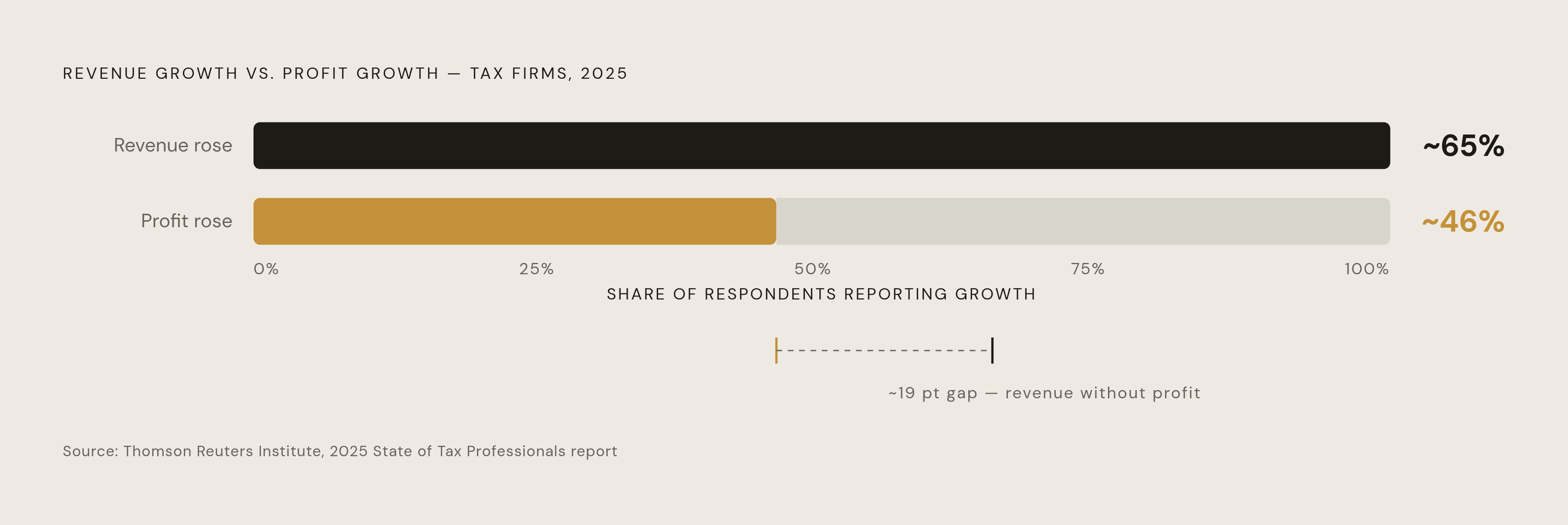
The squeeze comes from two directions at once. Inflation, wage growth, and the cost of practice software compress margins from the inside, while clients ask for more strategic advice and faster turnaround with no expectation of paying proportionally more for it. The Thomson Reuters Institute's 2025 Tax Firm Pricing Report shows the resulting split: almost two-thirds of respondents saw revenue rise, but fewer than half saw profit rise. That gap has nothing to do with capacity or demand. It's a pricing and positioning failure, and it's exactly the failure value-based pricing is built to correct.
Where the profession stands on adoption
Compliance work has already tipped. Ignition's benchmark shows only 3% of firms still bill tax prep hourly, while 79% have moved to fixed or tiered monthly packages for bookkeeping. Advisory work is the remaining frontier, and the holdouts are telling on themselves. Seventeen percent of firms still charge hourly for tax planning and advisory, down from 20% the year before, and that lingering number points to something specific: this is the work firms feel least confident pricing any other way, because it's the most bespoke and the hardest to standardize.
The confidence gap appears directly in the Thomson Reuters data. Most tax professionals believe their rates are competitive with the market. Far fewer, only 19%, say they feel highly confident their pricing reflects the value they actually deliver. Fewer than one in ten survey their own clients about pricing satisfaction, and fewer than one in five demonstrate ROI to a client in any concrete way. Firms are pricing in the dark and calling it competitive.
The fear holding firms back has a number attached to it, and the number doesn't hold up. Ignition's benchmark puts 28% of firms citing fear of losing clients as the top reason for not raising prices, with another 8% citing plain uncertainty about competitor pricing. That fear turns out to be mostly unfounded: two-thirds of firms that raised prices in the past year either lost no clients at all or lost a few and still came out ahead on profitability. The holdouts are protecting a number on a spreadsheet that was probably already too low, while competitors willing to test the market capture the revenue those holdouts leave behind.
How to diagnose what a client engagement is worth before setting a fee
The fee cannot be set before the diagnostic is done, and the diagnostic cannot happen after the engagement letter is signed. It has to come first, or the sequence is broken. Pulling prior-year returns, reviewing entity structure, and identifying unrealized strategies before quoting a number means the fee reflects what was actually found in the client's situation, not what gets filed at year-end on autopilot.
Retirement plan optimization, entity election changes, cost segregation studies, income timing strategies, charitable giving vehicles: any one of these, found and acted on, can be worth multiples of a standard prep fee. Missed, they represent value the firm never gets paid for because nobody went looking.
The SmartPath pricing framework anchors this diagnostic around two questions, and the order matters. First: what does the client want to make progress on in the next twelve months? Second, and this is the one that does the real work, what impact will that progress actually have on their life or their business?
A client who says "lower my taxes" has handed the firm a task. A client who says "lower my taxes so I can afford to hire my first employee" has handed the firm a reason, and that reason is what justifies a fee beyond a commodity return. It also gives the client a reason to say yes to that higher number, because the fee is now tied to something they actually want.
None of this needs to roll out across the entire client base on day one. Start with a handful of clients whose situations carry enough complexity to make the exercise worth running. The output is a clear picture of what progress looks like for that one client, and that picture is the only foundation a defensible fee can actually stand on.
Calculating the full price across five categories of value most firms underuse
The SmartPath framework shows nine out of ten tax firms bill for only one or two service categories out of five available to them. That statistic alone explains a large share of the margin gap between firms that feel squeezed and firms that don't, and it means most firms are sitting on unpriced work without realizing it.
Setup and onboarding, QuickBooks configuration, payroll activation, S-Corp elections, EIN filings, gets performed for free by most firms without anyone noticing it happened. Compliance and tax preparation is the foundation most engagements are built on, and also the category most exposed to automation if it's the only thing being sold. Done-for-you management, monthly bookkeeping, payroll processing, IRS correspondence, is work clients pay for because it buys back hours of their own time. Tax reduction planning, the ongoing strategic work of lowering a client's liability through reasonable compensation analysis and proactive planning, is the category most often given away free on an initial phone call. Strategic business guidance, cash flow analysis and broader advisory work, is arguably the most valuable thing a tax professional does all year, and it's the category that almost never makes it onto a proposal.
Pricing across all five, instead of the usual one or two, produces what SmartPath calls Total Contract Value. It combines hard costs specific to the client, services rendered across every category that actually applies, the time required (used to scope the engagement, not to generate a bill), and a value margin layered on top for complexity and expertise. That value margin is compensation for judgment the hourly model never had a mechanism to price in. Running through these five categories for a single current client, honestly, reveals that there are likely two or three sitting there with money left on the table.
How tiered packages and fee benchmarks shape pricing structure
Once value has been diagnosed and calculated, it needs a structure to sit inside. The Good-Better-Best model puts compliance work in the base tier, advisory services in the middle, and senior-level advisory support at the top, a set of variably priced bundles built for clients who value different things.
Thomson Reuters describes a similar three-tier architecture, basic, standard, premium, with modular add-ons like education planning, entity structuring, and succession planning layered on top. The design standardizes the menu without forcing the firm to reinvent scope from scratch for every client.
SmartPath's customization principle adds a nuance: the underlying menu should be standardized, but the specific combination presented to any one client needs to feel built for them. Clients expect to configure an engagement now, not pick an item off a shelf.
Ignition's 2025 benchmarks give the tiers something to calibrate against. Individual tax returns most commonly run $400 to $599, reported by 27% of firms. Business tax returns most commonly fall between $1,000 and $1,499 annually, per 29% of firms. Tax planning and advisory is where the numbers open up: the largest single segment, 25% of firms, charges more than $2,000 annually for it. CFO and controller services top the list, with 23% of firms pricing above $2,500 a month.
Project-based work, entity restructuring, cost segregation studies, estate plan modeling, follows a different pattern: a flat rate is quoted before work begins, with a defined deliverable and a deposit collected up front. That's standard practice for any standalone advisory engagement, and any firm still quoting these projects hourly is working against its own market. A firm that hasn't touched its advisory rates in two years should read these benchmarks as a wake-up call.
Presenting pricing so clients see the value before they see the fee
Sequence changes everything in a proposal. Open with projected savings or risk mitigated, walk through the scope of work second, and present the fee last, so the number lands against an anchor the client has already absorbed instead of arriving cold with nothing to measure it against.
The anchoring effect is straightforward: a meaningful annual fee positioned next to a projected savings figure several times larger reads as a return on investment. The exact same fee, shown first with no anchor in front of it, reads as an expense. Nothing about the number changes. Only the order of information does.
Clients bring a short, consistent list of expectations to this conversation. They want to know what they're paying before work starts, the same way they'd expect a price before hiring a contractor or a lawyer. They want the fee tied to something they're actually trying to accomplish. And they want to feel like they configured this engagement rather than accepted whatever package happened to be sitting on the shelf.
Firms that demonstrate ROI explicitly have an open lane right now: per the Thomson Reuters data, fewer than one in five currently do it. That's a differentiator any firm can adopt tomorrow, no new technology, no new hires, just the willingness to quantify the outcome inside the proposal itself.
Once a client understands what they're paying for before the engagement starts, they stop tracking hours and start collaborating on outcomes. That shift gets set in the pricing conversation, not somewhere later in the engagement. Clients seem willing to go along with it: 78% of respondents said client billings still got paid on time even after price increases, per the Thomson Reuters Institute's State of Tax Professionals data. Collection practices are moving the same direction, too. Ignition's 2025 benchmark shows 31% of firms now collect a deposit up front, up from 26% the year before, a structural reinforcement of the same value-first framing.
What firms that have made the transition report about revenue, confidence, and client retention
The confidence gap that plagues hourly and fixed-fee firms narrows once subscription-style pricing enters the picture. The Thomson Reuters Institute's 2025 report found that nearly one-third of tax professionals at subscription-first firms report high confidence their pricing aligns with the value they deliver, a materially higher share than among firms still billing hourly or by flat fee alone.
Subscription billing has grown substantially over the past year, though it's still far from the majority model. Firms adopting it now are building an advantage while the field is still open. Demand for the advisory work driving those subscriptions is already established: per Wolters Kluwer's Future Ready Accountant Report, 93% of accounting firms now offer advisory services, up from 83% the year before, and clients are increasingly seeking strategic business advice from their accountants. Pricing has to catch up to meet demand that already exists.
The revenue case has data behind it too. The firms that have moved away from hourly billing report higher revenue per client, a pattern consistent with the broader shift toward fixed and subscription pricing across the profession than firms still billing exclusively by the hour. The Thomson Reuters Institute's 2025 Tax Firm Pricing Report found that while most firms saw revenue rise, fewer than half saw profit rise alongside it. Most of that spread traces to pricing structure and service mix, not to differences in technical skill, which is the part hourly billing never let a firm capture.
None of this happens on a short timeline. A full transition realistically takes one to two years of deliberate work beyond a single pricing memo sent to clients in January. Firms succeeding at this aren't charging more for the same return they filed last year. They've built a repeatable process for finding more value in a client's situation, explaining that value in terms the client actually cares about, and capturing it consistently, year after year, instead of leaving it on the table the way an hourly invoice always did.
The operational infrastructure that makes value-based pricing repeatable at scale
Value-based pricing works as a one-off exercise if the goal is a single well-priced engagement. Turning it into a business model requires infrastructure, including a standardized diagnostic applied to every complex client, a documented five-category value calculation instead of a gut-feel number, a tiered package menu built once and reused with client-specific configuration, and a proposal template that sequences value before fee every time, not just when someone remembers to.
Firms that treat this as a one-time project rather than a system slide back toward old habits within a year or two: quoting from memory, giving planning advice away on the phone, pricing the return and forgetting the four other categories sitting next to it. The firms holding onto the gains built the diagnostic and the pricing conversation into the actual workflow of the practice, so the fee reflects the client's situation by default, not by exception.
That's the real dividing line in the profession right now, and it has nothing to do with whether a firm calls its model hourly, fixed, or value-based. It comes down to whether a firm has built a repeatable way to find value in a client's situation and get paid for it, or whether it's still pricing off the habits hourly billing left behind long after the rate sheet changed.
Sources
- Ignition Report Shows Shift in Pricing for Accounting Firms
- New report shows tax, audit & accounting firms need to optimize pricing for profitability in 2025 | Thomson Reuters Institute
- How to Price My Tax Services? A Complete Guide for 2026 - SmartPath
- 2025 U.S. Accounting and Tax Pricing Benchmark | Ignition
- thomsonreuters.com