Standard Operating Procedures for Tax Firm Workflows
Convert tribal knowledge into repeatable systems that survive seasonal volume.

Most tax firms are not running a process. They are running on the memory of their best people, and that model breaks predictably under seasonal volume. A standard operating procedure is the structural fix, converting what lives in a senior preparer's head into a repeatable system that works regardless of who is in the room. The five workflows where that conversion matters most are client intake, document collection, return preparation, multi-tier review, and client communication. This piece explains why each one fails without documented process, and how to build the SOPs that stop the annual recurrence.
The failure pattern is easier to recognize than to diagnose from inside it. When the process lives only in a senior person's head, and that person is in review or a client meeting, the whole firm stalls. Junior staff cannot act. Partners become full-time help desks for questions that a written procedure would have answered before they were asked. The firm is not understaffed in the ordinary sense. It is carrying its operating system inside one or two minds, and every interruption to those minds becomes an interruption to the entire engagement pipeline.
That model also produces a particular kind of exhaustion. Each season feels harder, not because the work is objectively more difficult, but because complexity compounds while no root cause is ever fixed. The cycle repeats because the underlying process was never given a fixed form that could be examined, tested, and improved.
Seasonal staff make the fragility visible in ways that permanent staff can absorb. Without documented processes, temporary hires take longer to ramp, and the cost of that ramp is paid by the exact people the firm cannot spare. Tools like Marble, which maintains client context and drafts memos from research citations, can absorb some of that repetitive backend work once the underlying process is documented, but the tool cannot substitute for the documentation itself. The sequence matters: first decide which decisions belong in a process and which belong in someone's head, then layer in the automation that handles the process.
What SOPs actually do that tribal knowledge cannot
A standard operating procedure converts tacit knowledge into a repeatable, transferable system that performs consistently regardless of who is in the room. It cannot be delegated to a new hire, it cannot be measured against a standard, and it cannot be improved through iteration, because it has no fixed form. A senior preparer may know exactly how to handle a complex Schedule C with mixed-use assets, but that knowledge leaves the room when she does.
An SOP gives the same knowledge a fixed form: required inputs, defined steps, named owners, and explicit handoff criteria. The operative consequence is that a preparer at any experience level knows what "ready for review" means without asking. That phrase, ready for review, carries the entire argument. When its meaning exists only in the reviewer's judgment, every handoff becomes a negotiation. When it is written down, with the workpapers required, the note format expected, and the open questions that must be resolved before the file changes hands, the handoff becomes a mechanical step.
The measurable benefits follow from that fixed form. A process that is consistent can be measured. A process that can be measured can be improved. A process that lives in someone's head offers neither possibility, because there is nothing to measure against and no baseline from which to improve.
Once a process is documented, it becomes measurable and improvable, and tools can then be layered in to handle the documented routine work while staff focus on the judgment calls that require experience. An AI tax research assistant that can draft documented reasoning and regulatory context makes review efficient rather than an archaeological dig, but only when the firm has already standardized what ready for review means. The tool accelerates a defined process. It does not define one.
The downstream benefit extends to clients as well. A client who knows that every document request will arrive in the same format, with the same follow-up cadence, experiences the firm as organized and reliable. That experience is itself a client retention argument, and it costs nothing beyond the discipline of writing the process down.
The predictable objection is that documenting processes takes time that firms do not have during busy season. The return is in-season, when the firm no longer pays for improvisation in lost hours and repeat mistakes. A firm that cannot find time in October to document its processes will pay for that omission in March, with interest.
The five workflows where inconsistency does the most damage
Not every workflow carries equal risk, and the five that break most visibly and most expensively under volume are client intake, document collection, return preparation, multi-tier review, and client communication. A firm can tolerate inconsistency in less frequent work without material harm. It cannot tolerate inconsistency in the journey a return travels from client request to final delivery.
Most firms that begin documenting SOPs start with these five for exactly that reason. The goal is not comprehensive documentation for its own sake. It is coverage of the points where failure is most expensive.
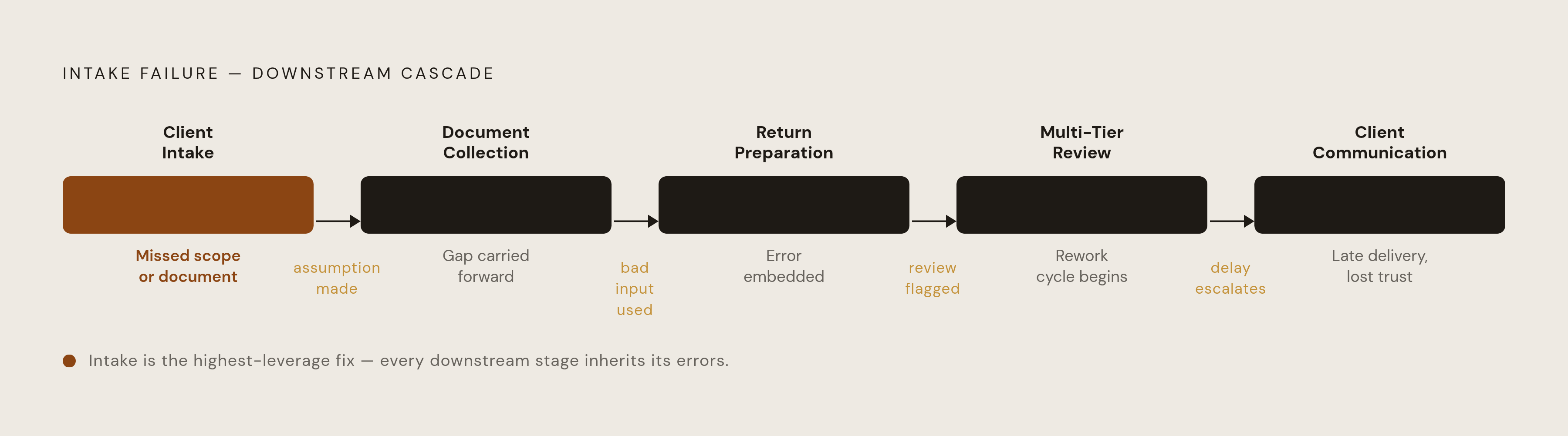
The order also matters operationally. A weak intake SOP creates problems that cascade into document collection, which cascades into preparation, which cascades into review. A missed document at intake becomes an assumption in preparation, which becomes a review note, which becomes a rework cycle. Fixing the workflows in sequence prevents downstream failures, because each stage inherits the cleanliness of the stage before it. The next four sections follow that sequence.
Client intake and document collection: where the return either starts clean or doesn't
Most firms collect documents reactively and through multiple uncoordinated channels, which means preparation begins before the file is actually complete. Documents arrive through email attachments, portal uploads, physical delivery, and sometimes text messages. Each channel creates a separate stream that someone has to monitor, reconcile, and organize before the return can move forward. All three outcomes create delays or errors, and none of them is the preparer's fault.
That sequence is structurally backward. A document collection SOP reverses it. It defines required documents by return type, establishes a single intake channel, sets a completeness check before the file is assigned to a preparer, and specifies the follow-up cadence for missing items. The completeness check is the pivotal step. It means the file is verified against a written list before anyone begins work on it, not discovered to be incomplete halfway through preparation.
Intake is also where scope is set. A strong intake SOP includes a pre-engagement scope conversation, conflict and independence checks, and an engagement letter signed before preparation begins. Establishing scope in writing at intake, before work starts, is far less expensive than negotiating it mid-season.
The operational test of whether intake is working is simple. If the intake SOP is functioning, those answers are visible without asking the partner. If the partner must be consulted to know the status of any given file, the SOP is not yet doing its job.
The One Big Beautiful Bill Act gives firms a concrete reason to revisit intake SOPs now. The 1099-NEC and 1099-MISC reporting threshold moves from $600 to $2,000 for 2026, which means vendor-tracking checklists and client instructions built around the prior threshold are now incorrect. The regulatory change forces the question: when was the intake SOP last reviewed against current law, and who owns that review?
Return preparation and multi-tier review: the handoff where errors either get caught or filed
Review delays and errors at this stage are almost always a handoff problem, not a competence problem. What neither party has is a shared definition of when work is ready to move between them. The reviewer cannot proceed and sends the file back, consuming time from both parties and delaying the queue for everyone behind it.
The structural fix is a separation of duties. The staff member who prepares a return should not conduct the first review. That separation catches calculation errors, missed deductions, and incorrect allocations before they reach the signing partner, because a second set of eyes with no stake in the preparation is more likely to see what the first set missed. A preparation SOP defines what ready for review means in concrete terms: which workpapers are required, how review notes should be written so they are specific, actionable, and clearable, what open questions must be resolved before handoff, and who owns each step.
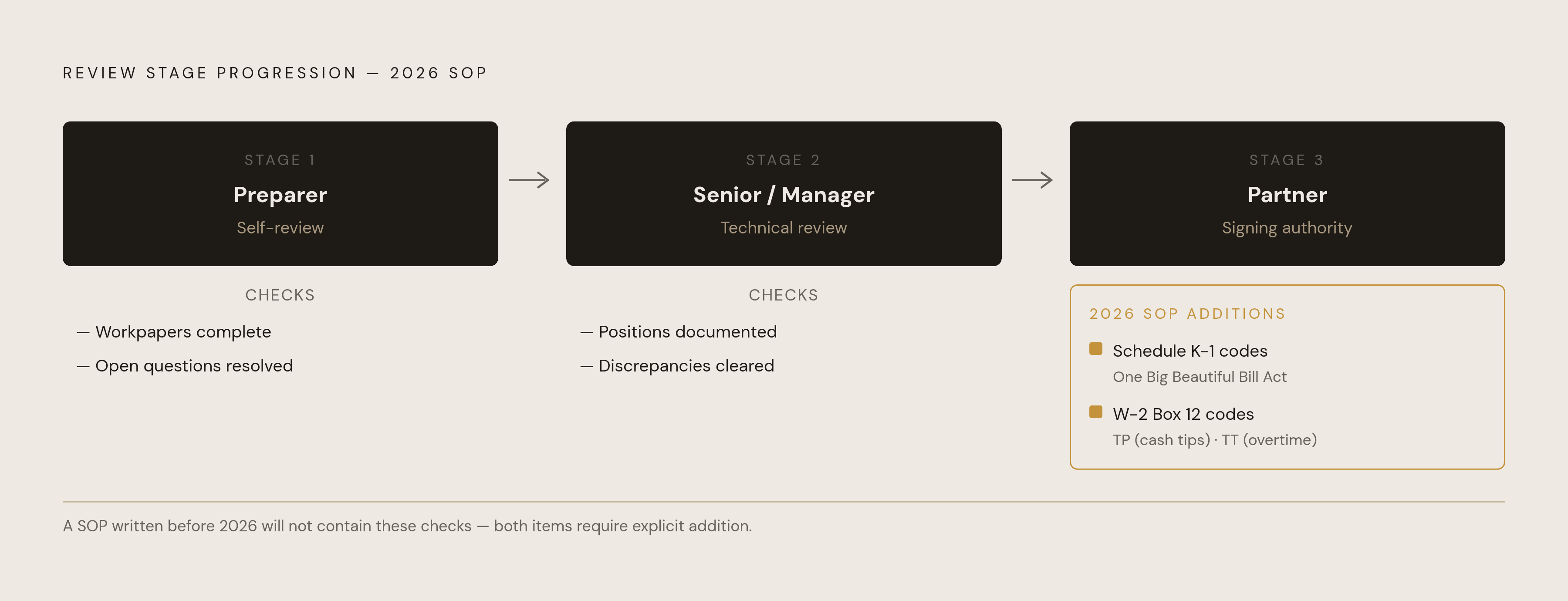
The multi-tier structure itself should be documented, not assumed. CPA Pilot's 2026 checklist maps the milestones explicitly: first preparer review, senior or manager review, and partner review, each with a named owner and purpose. When a partner spends review time correcting data entry, the firm is paying its most expensive judgment for its cheapest work, and the review queue backs up behind work that should never have reached that level.
For partnership returns, the stakes are higher because the errors compound. Every error on Form 1065 flows downstream to each partner's Schedule K-1 and personal filing. Instead's 2026 partnership workflow guide notes that this makes a documented review SOP a reputational risk control, not just an efficiency measure. New for the 2025 tax-year partnership returns filed in 2026, firms must verify compliance with new Schedule K-1 reporting codes introduced under the One Big Beautiful Bill Act. The review SOP should include an explicit step confirming those codes are correctly applied before the return is approved.
W-2 preparation carries a parallel requirement for 2026. The review SOP must now confirm separate reporting of cash tips reported to the employer under Box 12 Code TP, and qualified overtime under Box 12 Code TT, both under the OBBBA. A review SOP written two years ago, before these codes existed, will not catch an error in them. This is the argument for SOPs as living documents rather than set-and-forget checklists: the regulatory environment changed materially in 2025, and any review process built before that change is incomplete by definition.
The efficiency case is concrete. Scottsdale CPAs, PLLC reported that eliminating data silos and manual handoffs allowed the firm to process more returns with better quality and less stress. The review SOP exists so that a return moves through its stages without stopping for clarification, without returning for missing pieces, and without a partner serving as a human exception handler for every unclear handoff.
Client communication: the workflow most firms treat as informal and most clients experience as the firm's quality
Client communication is not a soft skill problem. A client who receives a document request from one staff member, a status update from another, and an extension explanation from a third, each in a different voice and format, concludes that the firm does not have its house in order. The client is often right.
Late client changes, the kind that force rework near filing deadlines, usually trace back to an absence at the engagement start. A communication SOP fixes this at the outset, not mid-season. Standardized templates for document requests, missing-information follow-ups, status updates, and extension explanations mean every client gets the same clear message regardless of which staff member sends it.
Future Firm's workflow guide frames this as expectation-setting. Packages and engagement letters must spell out specific deliverables, clear timelines, communication boundaries, and client responsibilities, including what clients must provide and by when. When those expectations are written into the engagement, scope creep and missed deadlines become the exception rather than the norm. The client knows what the firm will deliver, when, and what the client must do to keep the schedule intact.
Standardization also solves a scalability problem that becomes acute in peak season. QX Accounting's 2026 guide notes that when communication is standardized, outsourced support teams and seasonal staff can send consistent messages without needing partner approval for every outbound email. The partner's judgment is reserved for the communications that actually require it, rather than being consumed approving routine follow-up language.
Two communications carry heightened risk and deserve explicit template treatment. Extension communications must always state that an extension gives more time to file, not more time to pay. A proactive client communication SOP should include a template for explaining these changes before clients call with questions, which reduces inbound inquiry volume during the peak weeks when the firm can least afford to be answering the same question repeatedly.
How automation fits into a workflow built on SOPs — and where it introduces new risk
Automation is most valuable when it removes repetitive administrative steps from a workflow that already has defined ownership, clear handoffs, and documented review gates. Deployed without that foundation, it accelerates chaos rather than eliminating it. A firm that automates an inconsistent intake process gets inconsistent results faster.
The right automation targets for tax firms are the repetitive administrative steps: document request reminders, status updates, e-signature collection, and workpaper routing. Automation does not belong in judgment-based steps like position review or client advice, where the professional's reasoning is the deliverable. The line between those categories should be drawn deliberately, in the SOP, before any tool is connected to the workflow.
AI introduces a specific category of risk that existing SOPs were not built to manage. Both risks are behavioral, not technical. They arise because staff begin to trust the tool rather than verify its output, and because volume pressure makes verification feel optional.
A longer-term risk compounds the first two. Staff who develop expertise in operating AI tools rather than in the underlying tax law leave the firm without independent analytical capability precisely when it needs it most, handling complex matters or catching the errors the AI produces. The tool is only as reliable as the last human who checked it, and if no one in the firm can independently assess the tax law, there is no check.
The privilege question is no longer hypothetical. In United States v. Heppner, Judge Jed Rakoff of the US District Court for the Southern District of New York ruled from the bench on February 10, 2026, with a written opinion issued February 17, 2026, that a defendant's communications with a publicly available AI platform were not protected by attorney-client privilege or the work product doctrine. Firms need explicit SOP guidance on which AI tools are permissible for which tasks, because the default assumption that a widely available AI platform confers the same protections as a firm's own systems no longer holds.
CPA Pilot's 2026 checklist reflects the appropriate posture: AI should support CPA judgment, not replace professional review. The practical implication for SOPs is that any firm deploying AI in its workflow needs an AI governance section in its review SOP. That section must define permitted tools, prohibited data uploads, required human review gates, and escalation triggers for when AI output cannot be verified.
Purpose-built tools designed for tax workflows, including Marble, are built around these constraints from the start, with automation targeted at the intake and document-handling steps where repetition is highest and judgment is lowest. The design philosophy keeps practitioners in charge of the work that requires expertise. That is the right boundary, and it is one a firm can only maintain if its SOPs draw the same line independently of whatever tool it adopts.
Building SOPs before the season starts: a sequenced approach for firms starting from scratch
Firms that wait until the queue is overloaded to fix their processes solve the wrong problem. The window for building SOPs is the off-season, and the sequence matters as much as the content. The off-season is quieter, which is precisely when the structural work can actually happen.
Start with the highest-volume, highest-risk workflows first: client intake, document collection, and multi-tier review. Once the review SOP defines what ready for review means, the communication SOP can report status using the same categories. The early SOPs become the vocabulary the later ones rely on.
Capacity planning is part of SOP design, not separate from it. A firm that knows its March volume by week, and knows which staff are qualified for which returns, can spot the overload before it arrives and adjust. A firm that discovers the overload when it is already behind cannot.
The One Big Beautiful Bill Act makes this the wrong year to skip the exercise. Any firm updating its SOPs for 2026 must incorporate the raised 1099-NEC and 1099-MISC threshold, the new W-2 Box 12 codes for cash tips and qualified overtime, and the new Schedule K-1 reporting codes. These are not optional updates. They affect the accuracy of returns filed this season, and a firm that files inaccurate returns because its documented process predated the law is in a worse position than one that never documented anything at all.
Regulatory monitoring should itself be an owned workflow. CPA Pilot's 2026 checklist recommends assigning one person or a small team to monitor IRS filing-season announcements, form changes, and e-file guidance on an ongoing basis. The SOP for monitoring regulatory change is a workflow that needs an owner, because changes that no one is responsible for noticing will go unnoticed until they surface as filing errors.
SOPs are not finished documents. They are living ones. A firm at that point has stopped running on memory. It is running on a system it can see, measure, and improve.