AI Platforms That Handle Filing Season Client Work for Independent Enrolled Agents
Automation removes filing season bottlenecks without replacing tax judgment or EA responsibility.

AI platforms help independent enrolled agents scale without hiring when they automate the work that consumes filing season, including document intake, extraction, routine preparation, and research. The right platform addresses the practice’s actual bottleneck while leaving tax judgment and compliance responsibility with the EA. Capacity grows when less time goes into moving information and more goes into reviewing its tax consequences.
Why filing season hits independent enrolled agents differently than it hits firms
An independent EA has no associate to chase documents, no administrator to triage intake, and no senior reviewer to catch errors. All of that work falls to the same person who alone bears Circular 230 responsibility. The constraint is not simply the amount of work but its seasonal compression. A large share of annual revenue arrives in a narrow window, so an hour spent sorting documents cannot also serve a billable return or a judgment call.
That trade-off matters because EAs have unlimited practice rights before the IRS, including representation, appeals, and collections. The credential that carries compliance responsibility also supports an advisory premium. Yet routine administrative work competes directly with the work that calls on that authority. Automation therefore has value when it removes that competition.
The solo structure also makes a poor tooling decision harder to absorb. A firm can redirect work while someone resolves a software problem, but an independent practitioner has no staff buffer. Adoption timing and workflow fit consequently matter as much as the tool’s capabilities. A recommendation suitable for a staffed accounting firm does not automatically transfer to a one-person tax practice.
What AI platforms are actually automating in a tax practice right now
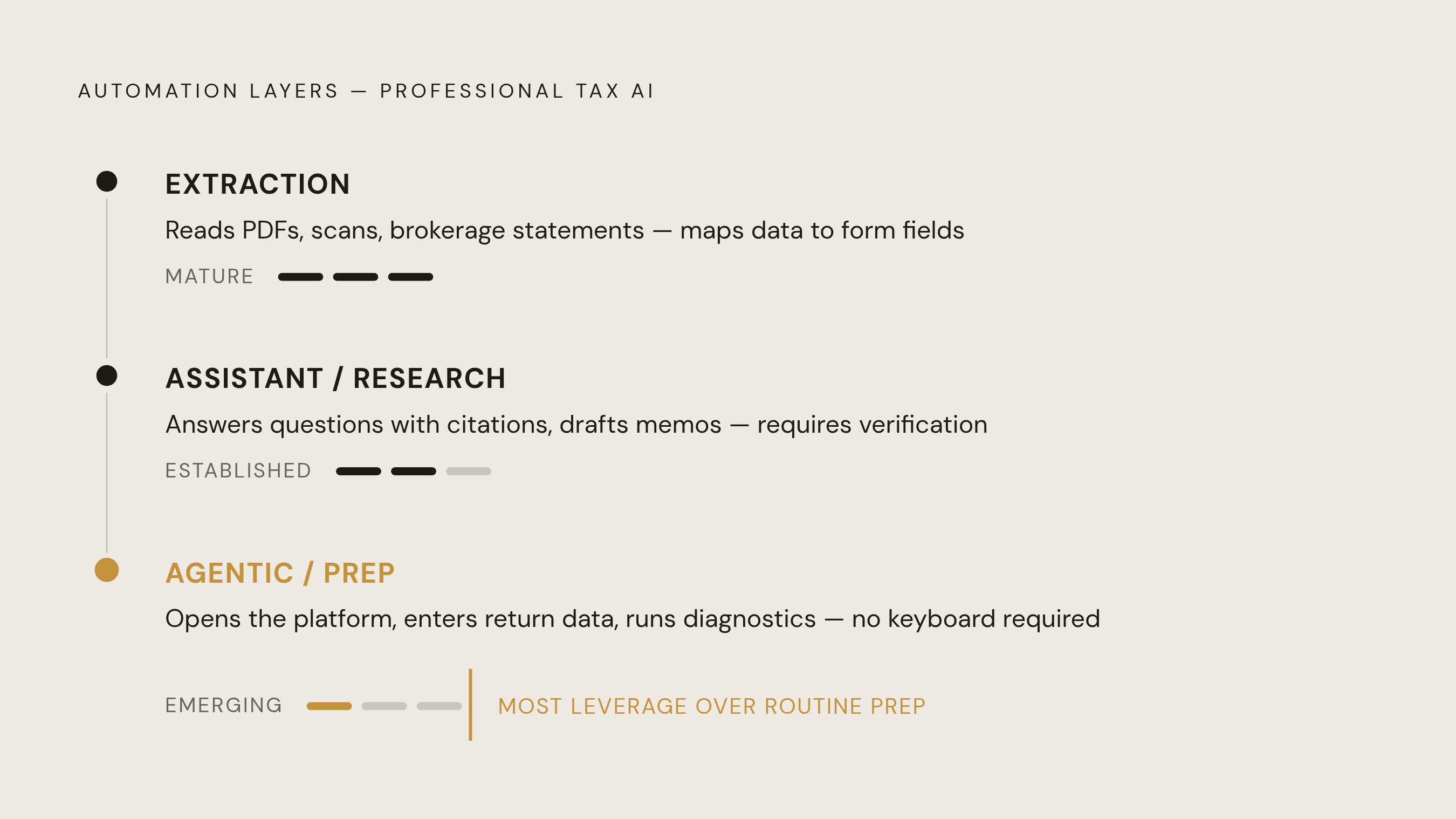
Professional tax AI now works at three layers: extraction, assistant/research, and agentic/prep. Extraction reads PDFs, scanned documents, and brokerage statements and maps the data in them to form fields. It is the most mature and reliable layer. The assistant/research layer answers tax questions in plain language with citations and drafts memos and client communications. Its output can shorten the research front end, but it still requires verification.
The agentic/prep layer goes further, opening the tax platform, entering return data, running diagnostics, and flagging items for a person to review, all without anyone touching the keyboard. It is the newest tier and offers substantial leverage over routine preparation. That scope distinguishes it from software that extracts figures but leaves the practitioner to transfer them. With either function, the practitioner still needs to review the return.
Intake automation addresses a separate problem before preparation begins. It reads the prior-year return, generates a personalized document request list, tracks what has arrived, and files uploads into the correct folder. For a practitioner losing hours to document chasing, intake automation may save more time than faster research or automated entry. An EA who mistakes an intake bottleneck for a research bottleneck will buy a tool that solves the wrong problem.
The platforms available to a solo EA practice and what each one actually does
Drake Tax with SmartExtract gives an EA already using Drake a way to start without a large commitment. SmartExtract extracts data from W-2s, 1099s, and K-1s and populates returns after a mandatory preparer review step. It is free during the beta period and available in both Drake Tax Online and Drake Tax Desktop, with the desktop offering in beta. Drake’s Pay-Per-Return plan for tax year 2026 also includes a set of returns and charges for each extra individual return, with no annual subscription.
Wolters Kluwer announced TaxWise powered by Expert AI in October 2026 as an agentic platform aimed at independent preparers already using TaxWise. The platform organizes client documents, extracts and maps tax-relevant information, flags potential issues, and produces a review-ready draft return. It combines agentic AI, document intelligence, data extraction, and integrated CCH tax research. The preparer retains control by reviewing, editing, validating, and approving every return before filing.
SmartVault SmartRequestAI targets the document-chase bottleneck. It reads the prior-year return, builds a personalized request list, tracks status, and routes uploads into the correct engagement folder in SmartVault. It is priced as an add-on in bundles and can work with any prep platform. The relevant dependency is the SmartVault document workflow.
Blue J answers tax questions in plain English using citations from federal and state primary and secondary sources, handles follow-up questions, and drafts memos and client emails. It is priced as an individual annual seat. That model fits an EA whose time drain is difficult research, but it does not address document volume or data entry. The practitioner must still verify the authorities supporting an answer.
Marble also works at the assistant/research layer, answering federal and state tax questions with code and regulatory citations, writing drafts of client emails and memos, and keeping tax guidance that users can search. Its broader workflow includes client intake, document review, and compliance checks. Marble organizes research, documents, engagements, and returns around a shared client profile and project folders. Its intake function gathers documents through a secure client portal, extracts the tax data needed, and flags what is missing.
Why purpose-built tax tools perform differently from generic software retrofitted for tax work
Purpose-built and retrofitted tax AI differ in their architecture. Legacy tax platforms carry decades of code that was not designed for AI. Adding intelligence at the edges can improve individual steps without allowing it to coordinate the full engagement. A purpose-built platform instead starts with tax documents and tax logic as part of its data model. Document types, form fields, jurisdiction rules, and review queues are native objects.
That distinction matters when information needs to move from intake into research, analysis, or preparation. In a purpose-built approach, the design can organize those activities around the same client facts. For example, Marble keeps research within a client or engagement and adds extracted intake information to that client’s context. This illustrates the value of shared context without establishing that every workflow is automated. The design’s usefulness depends on how much repeated handling it removes from the EA’s actual work.
Architecture alone is not enough to establish operational quality. Retrofitted platforms may have large installed bases and mature document libraries built over years, while a purpose-built entrant may have thinner coverage of edge cases. Performance on handwritten logs and scanned K-1 footnotes therefore tests edge-case coverage that a clean demonstration may not reveal. Integration breadth matters as well because a tool that requires replacing the existing stack creates deployment friction. For a solo EA, a migration-dependent tool belongs in an off-season evaluation.
Where AI tax tools still fail and what that means for an EA's review workflow
Extraction reliability varies with the document. Clean W-2s and standard 1099s extract reliably, but performance degrades on handwritten mileage logs, scanned K-1 footnotes, complex brokerage statements with cost-basis adjustments, and multi-jurisdiction documents. These are not interchangeable inputs, even when a platform places them in the same review queue. AI intake should therefore be treated as a sorting assistant. Every passthrough entry still requires hand verification.
Research tools introduce a different failure mode because a citation can look authoritative without being real. The Tax Court’s opinion in Clinco, T.C. Memo. 2026-16, states, “Three appear to be hallucinations generated by a large language model AI,” about cited authorities. The practical consequence applies to Blue J and other research assistants alike. Cited sources must be independently verified before they reach a client memo or an IRS submission.
Platform accuracy claims also require careful interpretation because vendor-reported results are not independent benchmarks. Performance on a specific extraction workflow cannot establish reliability on a complete return. Reviewers should spend most of their time on flagged items and the types of documents the tool tends to misread, while still doing the checks the engagement needs.
What OPR Alert 2026-19 requires of an EA who uses AI in client work
OPR Alert 2026-19 interprets competence under §10.35 to include understanding the tools used in client work, their limitations and failure modes, and their risk of bias or error. For an independent EA, evaluating those limits is therefore a required part of adoption, before a problem occurs. A practitioner who adopts a tool without evaluating its failure modes is potentially out of compliance before a return is filed. The requirement connects directly to the document and citation risks that shape the review workflow. The OPR’s alert is the primary source to read before adopting AI for client-facing work.
OPR Alert 2026-19 says that cost savings should be passed on and disclosed openly. Under §10.27(a), billing for manual hours not worked or double-billing for AI-assisted tasks may constitute an unconscionable fee.
Data handling must also be settled before client documents move into a platform. The practical steps are to confirm the vendor’s data-handling terms, get §7216 consent in place, and verify that the tool is nameable in the practice’s WISP. Together with competence and fee review, they translate AI use into decisions the solo practitioner can make before client work begins. The platform can perform tasks, but it cannot absorb the EA’s professional responsibility.
How to evaluate an AI platform before adopting it as a solo EA
Begin by tracking where hours go across a sample of returns. Distinguish document chasing from extraction and entry, research and memo drafting, and return review. Then evaluate tools that address the largest time drain. This sequence gives the trial a defined purpose. It also prevents an attractive feature from becoming a substitute for an actual capacity gain.
Next, compare the pricing model with both return volume and the practice calendar. Drake Pay-Per-Return and SmartVault SmartRequestAI’s bundle pricing give practices other ways to pay instead of a year-round subscription that runs through the eight months when volume is low. With Blue J’s annual seat, the practice needs to weigh the full year’s cost against the season’s work. The calculation differs for a 150-return solo practice and a 500-return firm. A price that looks modest in isolation may be less useful than a narrower tool matched to the workload.
Then establish whether the platform layers onto the existing stack or requires migration. A tool that replaces the current tax engine cannot be tested safely during an active season. Before trial documents are uploaded, settle data-handling terms, §7216 consent, and the WISP requirement. Ask how well the tool works on the documents the practice gets, including K-1s, Schedule C source documents, and brokerage statements. An inability to answer specifically is itself an evaluation finding.
Finally, use trial availability to test fit before committing. Juno offers a free trial of 5 preparations with no credit card required, allowing a solo EA to run actual returns through the tool. Test tools that handle intake, preparation, or research in the same way. For research-heavy engagements, the time saved by an assistant such as Marble still needs to be weighed against the verification work that remains. The measure is usable capacity after review.
That capacity can support more valuable work without adding employees, but it does not become revenue automatically. Automating intake and extraction can free up hours for advisory work, while help with research can cut the time spent finding authorities. The practice must still be positioned to sell advisory services. The tools create time for the judgment calls the EA cannot delegate. The practitioner decides how to turn that time into a stronger practice.