Client Concentration Risk and Its Effect on Tax Firm Sale Price
Buyers discount concentrated client bases to account for post-close revenue risk.

Client concentration is the single biggest qualitative discount in a tax firm sale because it makes post-close revenue harder to predict. Buyers price that uncertainty into both the multiple and the terms of payment. Understanding those two mechanisms gives owners practical ways to protect firm value, but the strongest improvements require work well before the sale process begins.
Why buyers treat client concentration as a revenue prediction problem, not a relationship problem
A large client can be an operational success and an underwriting liability at the same time. For the owner, the relationship represents years of trust and dependable work. For the buyer, it represents cash flow that could disappear after the owner leaves. The acquisition debt would remain.
That contrast explains why assurances about loyalty rarely resolve the concern. Buyers need projected cash flows reliable enough to service the debt used to fund the purchase, and they discount concentrated revenue to account for uncertainty about its recurrence. Tax relationships sharpen the risk because a top-ten client lost after closing is typically permanently lost. Ashley-Kincaid identifies concentration as one of the highest-impact qualitative adjustments because it affects retention, cash flow predictability, and debt serviceability. For institutional acquirers, the concern flows through the leveraged buyout model used to set the offer.
The concentration thresholds buyers use and why the gradient matters
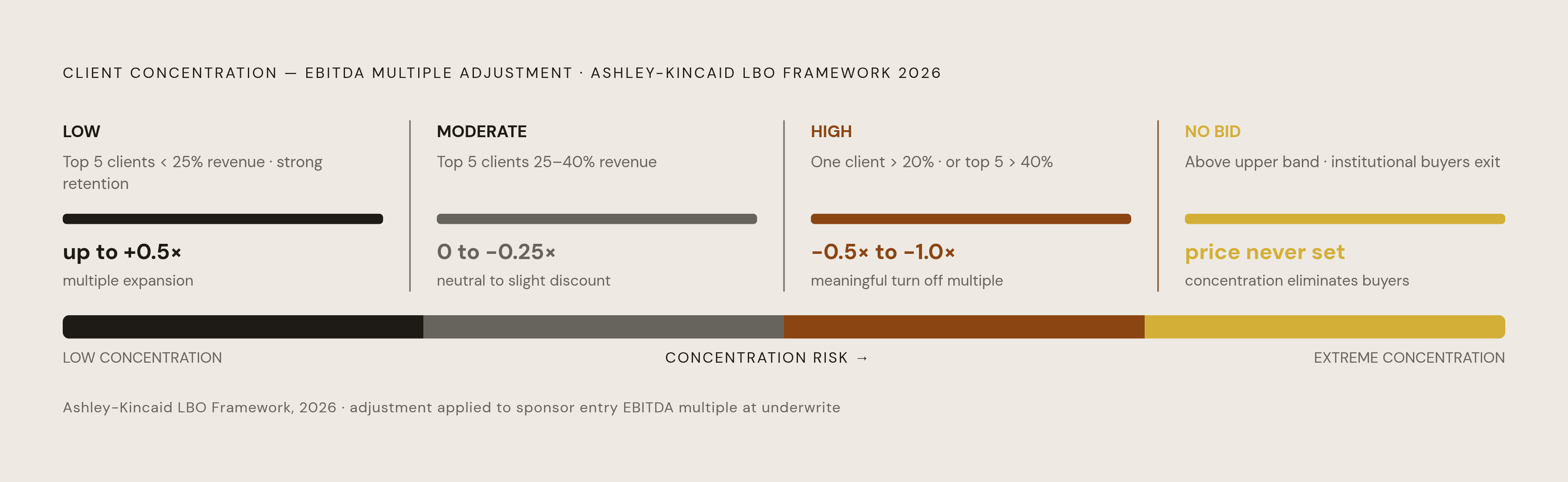
Ashley-Kincaid’s 2026 LBO qualitative adjustment framework treats concentration as a gradient. At the low end, a firm whose top five clients account for below roughly a quarter of revenue, with strong retention, can receive a positive adjustment of up to +0.5x on the multiple. With moderate concentration, the adjustment is neutral to slightly negative. One client above a fifth of revenue, or the top five above two-fifths, can trigger a strong negative adjustment, often a meaningful fraction of a turn off the EBITDA multiple.
Both measures apply at the same time. A firm can stay below the individual-client threshold while its top five relationships still represent an outsized share of revenue. The discount also steepens non-linearly, so crossing a threshold does not simply add another small deduction. Above the upper band, many institutional acquirers choose to make no bid. At that point, concentration reduces competition before the seller has an opportunity to negotiate the discount.
How concentration mechanically compresses the headline multiple
The concentration adjustment sits on top of the base multiple tied to normalized EBITDA margin. That distinction separates operating performance from the buyer’s confidence that performance will survive the transaction. A firm may have strong earnings today even when the buyer is unsure how much it will earn after closing. The buyer prices both.
The arithmetic is direct. Enterprise value is normalized EBITDA multiplied by the adjusted multiple, so a downward concentration adjustment cuts value even when revenue and margin stay the same. The dollar effect depends on the earnings base to which that adjustment applies. Ashley-Kincaid estimates that concentration alone can swing enterprise value by hundreds of thousands to well over a million dollars for mid-sized firms.
With the same revenue and margin profile, the diversified firm can receive a materially higher multiple and a far larger cash-at-close share than the concentrated firm. The earnings are comparable, but their perceived durability is not. However, multiple compression is only the first mechanism, because payment terms determine how much of the negotiated value the seller actually receives.
How concentration reshapes deal structure and shifts risk onto the seller
Earnouts transfer the concentrated-client risk back to the seller. A buyer holds back a large share of the consideration at closing until the client has stayed for an agreed post-close period. Many PE deals tie payments over multiple years to client revenue retention thresholds in year one and cumulatively through year three. Missing those thresholds reduces or eliminates the payments. In the worst case, one concentrated client’s departure can erase a significant share of total consideration.
In accounting-firm M&A, a one-turn move in the headline multiple can be worth less than a 10-percentage-point shift in the cash-at-close percentage, because the contingent portion depends on retention the seller cannot fully control. Earnouts are not guaranteed proceeds. Treating them that way overstates the amount the seller can expect to collect and obscures the risk retained after ownership changes.
TMI Tax Services Group describes the consequences as a lower multiple, added earnout, held-back cash, a longer transition period, and customer-level diligence on the concentrated client. The deal therefore does more than assign a lower price to uncertainty. It assigns responsibility for that uncertainty to the seller. Sellers often discover the true cost only at closing, when a large share of the price they negotiated proves contingent.
Owner dependency as a second, compounding concentration risk
A few clients may supply much of the revenue while a single owner-preparer performs much of the work and holds the key relationships. Buyers underwrite those exposures separately. If the owner leaves and the buyer cannot replace that expertise, clients tied to the owner may leave as well.
The risks are distinct, but they often overlap. The highest-revenue clients may also be those whose relationship runs most directly through the owner, making the loss of one preparer a threat to several important accounts. Client acquisition alone does not resolve that dependency. For sellers, the operational response is to reassign account ownership to other preparers, document client preferences, and establish backup coverage, ideally in the one to two years before sale. This gives the buyer a relationship transition to assess rather than a promise that the founder will eventually step away.
Why PE's growing dominance in accounting M&A makes concentration thresholds stricter for every seller
PE-backed platforms now set the price in accounting M&A, making their concentration standards relevant even to owners who do not intend to sell directly to private equity. PE-backed strategic buyers want books where no single client brings in more than a small single-digit share of revenue and top-ten combined concentration is well below a third. These standards are stricter than the broad high-risk bands. They are also hardening as PE capital continues to enter the sector, so avoiding a severe discount is not the same as meeting the preferences of the highest-paying buyers.
Large transactions show the scale of the market in which those standards operate. Blackstone acquired Citrin Cooperman from New Mountain Capital in Q2 2025 at a premium valuation. The PE-sponsored combination of Baker Tilly and Moss Adams, backed by Hellman & Friedman and Valeas Capital Partners, closed in Q2 2025 at a substantial implied valuation. CBIZ bought Marcum in Q4 2024 in a cash-and-stock deal whose price was disclosed in SEC Form 8-K.
The effect reaches smaller sellers through the buyer pool. Firms willing to pay the highest multiples are also those applying the strictest concentration standards. A concentrated practice may lose those bidders before talks over price begin, even if other buyers still want to buy it. Fewer competitive bids weaken the seller’s negotiating position. The resulting discount reflects both the revenue risk inside the firm and the reduced competition outside it.
When concentration is a mitigant, not just a liability — and when that argument holds
A concentrated relationship is not automatically fatal to valuation. Long-term, multi-year service agreements that limit early termination without cause can make revenue less uncertain, especially when they pass cleanly to the buyer without the client having to agree again. Market-rate pricing also supports the case because it does not depend on a personal concession the new owner cannot sustain. A record of clients renewing even when staff change also helps show that the relationship belongs to the firm. These conditions can reduce the discount without removing the underlying dependency.
The reverse is less persuasive. Easily terminable contracts, annual agreements with no lock-in, below-market “friendship pricing,” and relationships that have never survived a preparer transition leave the central buyer concern unresolved. TMI distinguishes between reducing uncertainty and reducing dependency, because a contract does only the former. Buyers still need to assess what happens at renewal and whether the client stays without the founder. Tenure alone does not answer either question.
The discount estimates also require a qualification. They come primarily from M&A advisors with a commercial interest in encouraging pre-sale preparation. They are advisory-consensus estimates rather than neutral empirical measurements, although they are consistent across independent advisors and reflected in deal structures. That limits the precision with which any particular deduction can be predicted. Even a well-documented, long-tenured relationship retains concentration risk, so mitigation changes the degree of that risk.
What sellers can do in the twelve to twenty-four months before going to market
For sellers, the highest-impact response is proactive client diversification. New clients in complementary industries or geographies can expand the revenue base while preserving valuable relationships, and niche expertise can help attract prospects suited to the practice. Service tier development follows the same logic by converting one-time or low-volume clients into recurring advisory or compliance relationships.
Sellers should move concentrated-client account ownership to other preparers, document preferences, and build backup coverage before going to market. The transition needs time to become established. Contract formalization can then support that operational work through multi-year agreements with termination limits, market-rate pricing, and terms that transfer cleanly to a buyer. Neither step substitutes for diversification, but both can make the remaining concentration easier to underwrite.
Buyers also need evidence of progress over time. Data-room reports should show how concentration, retention metrics, and diversification have changed over time, along with the current revenue snapshot. Ashley-Kincaid recommends detailed concentration and retention analyses benchmarked against current PE buyer thresholds, followed by customized twelve-to-twenty-four month risk-reduction plans. Practice management tools built for this work can track progress, handle the routine work of moving relationships to other preparers, and keep the records that support it. That leaves practitioners more time for the advisory relationships that drive new client growth.
The return can extend beyond a higher multiple. Successful remediation can shorten or eliminate earnout exposure and widen the buyer pool, improving both the price and the certainty of payment. TMI notes that diversification can offer a higher return than almost any tax strategy available to the seller because it changes the total value available. The preparation window is measured in years. Sellers who wait until due diligence have already given up most of the value they could have gained by broadening the client base, giving relationship transitions time to take hold, and keeping records of retention.